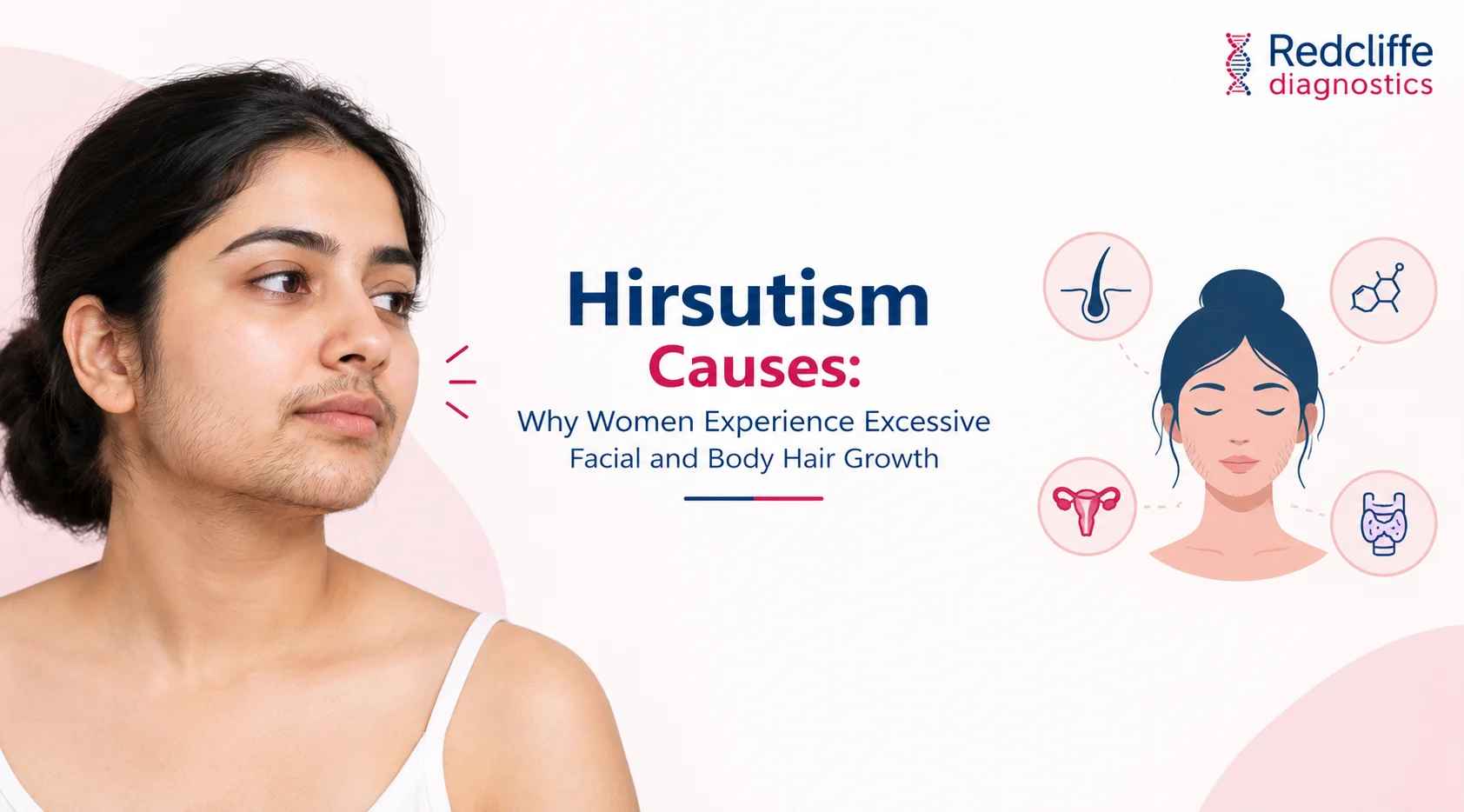
Hirsutism Causes: Why Women Experience Excessive Facial and Body Hair Growth
Overview
- Hirsutism causes coarse, dark hair growth on the face, chest, abdomen, and back in women.
- PCOS is a common cause, but adrenal disorders, certain medicines, and other hormonal factors may also contribute.
- In many cases, excess androgen activity or increased hair follicle sensitivity to androgens plays an important role.
- Sudden or rapidly increasing hair growth, along with other hormonal changes, requires medical evaluation.
- Hormonal tests may help identify the underlying cause when a healthcare professional recommends them.
- The Hirsutism Panel – Essential at Redcliffe Labs offers hormonal testing options for women experiencing excessive hair growth.
Noticing coarse, dark hair on the chin, upper lip, chest, abdomen, or back can concern many women. While some facial and body hair is normal, excessive growth in areas where men typically develop terminal hair may indicate hirsutism.
Understanding the causes of Hirsutism is important because excessive hair growth may sometimes be linked to hormonal changes or an underlying health condition, particularly polycystic ovary syndrome (PCOS). If you experience new or increasing hair growth along with irregular periods, acne, weight changes, or difficulty conceiving, a medical evaluation may help identify the cause.
What Is Hirsutism in Women?
Hirsutism in women refers to excessive growth of coarse, dark hair in a male-pattern distribution. Hair may become more noticeable in areas such as the:
- Upper lip and chin
- Sideburns
- Chest
- Upper or lower back
- Lower abdomen
- Inner thighs
Hirsutism is different from having naturally more body hair. Genetics and ethnicity can influence normal hair-growth patterns. Hirsutism is generally associated with increased androgen activity, increased hair-follicle sensitivity to androgens, or certain underlying medical conditions.
What Causes Hirsutism?
One key factor is androgen activity. Androgens, including testosterone, are often referred to as male hormones, but women naturally produce them too.
When androgen levels are higher than expected, or hair follicles are particularly sensitive, fine hair may become thicker, darker, and more noticeable.
Some important hirsutism causes include:
1. Polycystic Ovary Syndrome (PCOS)
PCOS is a common hormonal disorder affecting women of reproductive age and is one of the most frequent causes of hirsutism.
Women with PCOS may experience excessive facial or body hair along with:
- Irregular or missed periods
- Acne or oily skin
- Difficulty managing weight
- Thinning scalp hair
- Difficulty conceiving
If hirsutism occurs with these symptoms, your doctor may recommend hormonal evaluation and investigations for PCOS.
2. Increased Androgen Levels
The ovaries and adrenal glands produce androgens. Increased androgen production can stimulate terminal hair growth in androgen-sensitive areas.
In appropriate cases, tests such as Free Testosterone/SHBG and DHEA-S may be recommended to assess androgen status and investigate possible hormonal causes.
3. Adrenal Gland Disorders
The adrenal glands are another source of androgens. Certain adrenal conditions can cause excess androgen production and increased facial or body hair.
Depending on symptoms and clinical history, healthcare professionals may recommend tests such as DHEA-S or 17-OH Progesterone as part of the evaluation.
4. Other Hormonal Conditions
Not every case of excessive hair growth is caused by PCOS. Thyroid disorders and elevated prolactin levels may contribute to menstrual irregularities and other hormonal symptoms that warrant evaluation. Depending on the symptoms, a doctor may recommend tests such as TSH and Prolactin alongside investigations for androgen excess.
5. Certain Medicines
Some medicines can cause or worsen excessive hair growth. If you notice a significant change after starting a medicine, do not stop taking it on your own. Discuss the change with your healthcare provider, who can determine whether the medication could be contributing.
6. Idiopathic Hirsutism
Sometimes, women have excessive facial or body hair even when menstrual cycles and measured androgen levels appear normal. This is known as idiopathic hirsutism and may be related to increased hair-follicle sensitivity to androgens.
Family history and ethnicity can also influence hair-growth patterns.
Hirsutism Symptoms You Should Notice
The main symptoms of hirsutism involve the development of thick, coarse, pigmented hair in areas where women usually have finer hair.
Depending on the underlying hormonal condition, excessive hair growth may occur with:
- Irregular menstrual cycles
- Persistent acne
- Oily skin
- Scalp hair thinning
- Unexplained weight changes
- Difficulty conceiving
Seek prompt medical evaluation if coarse hair develops suddenly or progresses rapidly, particularly if accompanied by voice deepening, increased muscle mass, or other signs of virilisation.
Can Hirsutism Develop After Pregnancy?
Pregnancy and the postpartum period involve significant hormonal changes, and hair growth and hair-shedding patterns can change temporarily.
However, persistent or progressively increasing coarse facial or body hair after pregnancy should not automatically be attributed to postpartum hormonal changes. If it occurs along with irregular periods, acne, or other hormonal symptoms, consult a doctor to determine whether further evaluation is required.
Is Hirsutism Always Due to PCOS?
No. Although PCOS is a common cause, there are several other possible hirsutism causes, including adrenal disorders, certain medicines, other hormonal conditions, and idiopathic hirsutism.
This is why identifying the underlying cause is more useful than relying only on cosmetic hair-removal methods.
How Is the Cause of Hirsutism Investigated?
A healthcare professional may start by asking about your menstrual cycle, the onset and progression of hair growth, medications, family history, pregnancy history, and other symptoms.
Depending on the findings, investigations may include:
- PCOS-related assessment
- Free Testosterone/SHBG
- DHEA-S
- LH and FSH
- Prolactin
- TSH
- 17-OH Progesterone
Not every woman needs every test. The appropriate investigations depend on symptoms, medical history, examination, and a doctor's clinical assessment.
Explore the Hirsutism Panel – Essential at Redcliffe Labs
If you experience persistent excessive facial or body hair and your healthcare professional recommends a hormonal evaluation, the Hirsutism Panel – Essential at Redcliffe Labs can help assess key hormonal parameters. The results can support further evaluation when interpreted alongside your symptoms and medical history.
Book your test with Redcliffe Labs to explore the available testing options.
PCOS and Hirsutism: When Testing May Help
When excess facial or body hair occurs alongside irregular periods, acne, weight-related concerns, or fertility difficulties, polycystic ovary syndrome (PCOS) may be one possible underlying condition.
A PCOS Test or hormonal investigations recommended by a healthcare professional can help evaluate PCOS-related features and investigate other possible causes of excessive hair growth. The appropriate tests depend on your symptoms, medical history, and clinical assessment.
The PCOS Test Cost may vary depending on the tests or profile selected, location, and laboratory services. Consult a healthcare professional to determine which investigations are appropriate for you, rather than choosing tests based on symptoms alone.
When Should You Consult a Doctor?
Occasional facial hair does not necessarily indicate a hormonal disorder. Consider seeking medical advice if you notice:
- Rapid or sudden increase in facial or body hair
- Excess hair with irregular or absent periods
- Severe or persistent acne
- Scalp hair thinning
- Difficulty conceiving
- Deepening of the voice or other signs of increased androgen activity
Early evaluation can help determine whether the changes are related to PCOS, another hormonal condition, medication, or normal individual variation.
Takeaway
Excess facial or body hair can affect confidence, but it can also provide useful information about underlying hormonal health. PCOS is a common cause, but not the only explanation.
Understanding the causes of hirsutism and watching for associated menstrual, skin, hair, or reproductive changes can help you decide when a medical evaluation is appropriate. If excessive hair growth persists, worsens, or is accompanied by other hormonal symptoms, consult a healthcare professional. Appropriate hormonal tests can help investigate the possible cause and guide further management.
Medical Disclaimer: This information is for educational purposes only and is not a substitute for professional medical advice, diagnosis, or treatment. Consult a qualified healthcare professional for appropriate evaluation and testing.
FAQs
Can stress cause excessive facial hair in women?
Stress itself is not considered a direct cause of hirsutism. However, prolonged stress can affect hormonal and menstrual patterns in some women. New or increasing coarse facial hair should not automatically be attributed to stress. A healthcare professional can assess whether PCOS, androgen excess, medication, or another condition may be contributing.
Does hirsutism get worse with age?
Hair growth patterns can change with age, particularly around menopause, when the balance between estrogen and androgens shifts. Some women may notice more facial hair during this period. However, sudden or rapidly progressing coarse hair growth warrants medical assessment, especially when accompanied by voice changes, scalp hair loss, or other signs of androgen excess.
Can hirsutism occur even when hormone test results are normal?
Yes. Some women have idiopathic hirsutism, in which excessive terminal hair develops despite apparently normal androgen levels and regular menstrual cycles. Hair follicles may be more sensitive to normal androgen levels. A healthcare professional can determine whether further investigation is necessary after considering symptoms, menstrual history, medications, and examination findings.
Is hirsutism hereditary?
Genetics can influence the amount, thickness, and distribution of body hair. Hirsutism or increased hair growth may therefore occur more commonly in some families. However, family history does not rule out hormonal conditions. New, rapidly increasing, or symptom-associated hair growth should still be evaluated to identify any underlying medical cause.
Can hirsutism be permanently cured?
Whether hirsutism can be permanently resolved depends on its underlying cause. Treating a hormonal disorder may reduce new excessive hair growth, but existing terminal hair may require cosmetic treatments such as laser hair reduction or electrolysis. Because improvement takes time, treatment is usually individualised based on the cause and the woman's preferences.