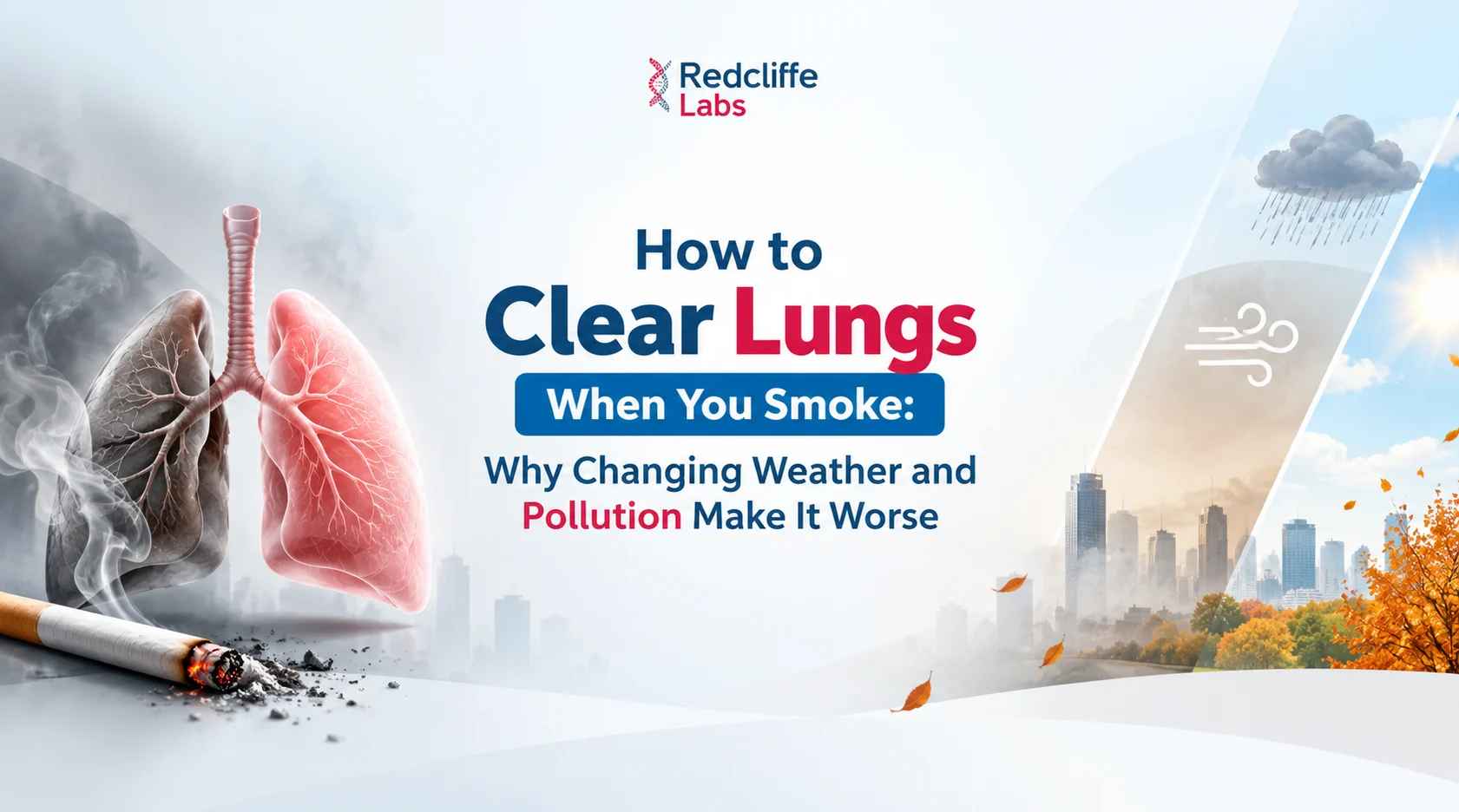
How to Clear Lungs When You Smoke: Why Changing Weather and Pollution Make It Worse

Overview:
- Smoking damages the lungs’ natural cleaning system, impairing mucus clearance and increasing the risk of persistent coughing, phlegm, and respiratory disease.
- Cold weather and air pollution can worsen coughing, wheezing, and breathing discomfort by further irritating sensitive airways, particularly in people who smoke or have existing respiratory conditions.
- Quitting smoking is the most effective way to protect lung health. Reducing exposure to polluted air, avoiding indoor smoke and staying active within your limits can also support respiratory health.
- Detox drinks, steam inhalation and the “7-second lung-clearing trick” cannot remove accumulated tar or reverse smoking-related lung damage.
- The Redcliffe Labs Smoking Impact Assessment Profile includes selected blood tests to assess blood counts, inflammation, liver enzyme levels, average blood glucose, and Vitamin D status. Persistent respiratory symptoms may require a separate clinical assessment.
Quick Answer:
You cannot completely clear your lungs of smoking-related damage while continuing to smoke. Quitting smoking, reducing exposure to air pollution, and avoiding other respiratory irritants are the most effective steps to protect your lungs. No drink, supplement, or home remedy has been proven to remove accumulated tar or reverse all smoking-related damage.
Can You Clear Your Lungs While You Still Smoke?
You can reduce exposure to additional irritants and support your respiratory health while you are still smoking, but these steps cannot cancel out the effects of cigarette smoke.
Your airways contain tiny hair-like structures called cilia. They help move mucus and trapped particles towards the throat so they can be cleared. Cigarette smoke damages these structures, increases mucus production, and interferes with the lungs’ natural cleaning process.
As a result, you may experience:
- A persistent morning cough: Mucus can accumulate overnight and become more noticeable after waking.
- Frequent phlegm: Your airways may produce more mucus or clear it less effectively.
- Wheezing or chest tightness: Irritation or narrowing of the airways can make breathing uncomfortable.
- Breathlessness during routine activities: This may indicate an underlying respiratory problem and should not automatically be attributed to smoking or poor fitness.
These symptoms do not necessarily mean you have chronic obstructive pulmonary disease (COPD), but persistent or worsening symptoms deserve medical assessment.
What actually helps your lungs when you smoke?
The most useful steps focus on reducing exposure and addressing the cause of your symptoms:
- Work towards quitting smoking. Counselling and appropriate stop-smoking medication can improve your chances of quitting successfully.
- Check local air quality. Reduce prolonged or strenuous outdoor activity when pollution levels are high.
- Reduce indoor irritants. Keep your home smoke-free and limit exposure to cooking fumes, dust and harsh cleaning chemicals.
- Stay active within your limits. Regular walking and other suitable activities support cardiovascular fitness, but exercise does not remove tar from your lungs.
- Get persistent symptoms checked. A long-standing cough, recurring wheezing or unusual breathlessness should not be managed with home remedies alone.
These measures can support your health, but quitting smoking remains the most important step for reducing further smoking-related harm.
Why Do Smoking, Cold Weather and Air Pollution Make Coughing Worse?

Smoking, cold weather and pollution can affect your airways in different ways. When these exposures occur together, an existing cough or breathing problem may become more noticeable.
1. Cigarette smoke increases irritation and mucus
Cigarette smoke contains harmful chemicals and particles that irritate the respiratory tract. It can increase mucus production and impair the cilia responsible for clearing mucus from the airways.
When mucus builds up, coughing may become more frequent. A smoker's cough should not automatically be considered normal, particularly if it changes, persists or occurs alongside breathlessness.
2. Cold, dry air can trigger coughing
Cold, dry air can irritate sensitive airways and trigger coughing, wheezing or chest tightness in some people. These effects may be more pronounced in people with asthma or other respiratory conditions.
If your cough worsens during winter, smoking may be one contributing factor, but it is not the only possible explanation. Respiratory infections, asthma, and COPD can also cause similar symptoms.
What you can do: Cover your nose and mouth with a scarf in cold conditions if it makes breathing more comfortable, avoid sudden exposure to very cold air when possible, and follow your prescribed treatment if you have an existing respiratory condition. A scarf may warm the air you breathe, but it does not filter pollution reliably.
3. Air pollution adds another source of respiratory irritation
Fine particulate matter, including PM2.5, can penetrate deep into the lungs. Other pollutants can also irritate the airways and aggravate respiratory symptoms.
For someone who smokes, outdoor pollution adds to the exposure from cigarette smoke. Avoiding one source does not cancel out the effects of the other.
What you can do:
- Check the local Air Quality Index (AQI) before planning outdoor activities.
- Reduce prolonged or strenuous outdoor exercise when air quality is poor.
- Choose routes away from heavy traffic where practical.
- Keep windows closed during periods of heavy outdoor pollution, while maintaining suitable indoor ventilation.
- If you must be outdoors in particle pollution, a well-fitting N95 respirator can reduce exposure to airborne particles. It does not protect against every gaseous pollutant or make heavily polluted air completely safe.
Also read: 11 Tips to Take Care of Yourself in Delhi-NCR Pollution
4. Smoking during a cough or cold can aggravate symptoms
A respiratory infection can inflame the airways and increase mucus production. Continuing to smoke exposes already irritated tissues to more smoke, which may worsen coughing and discomfort.
Avoid smoking while recovering from a cough or cold. Seek medical advice if symptoms worsen, breathing becomes difficult, chest pain develops, or you are not recovering as expected.
What Can You Do to Protect Your Lungs When You Smoke?
Along with working towards quitting, a few practical changes can help reduce exposure to irritants and support your general health.
1. Get help to quit smoking
Quitting removes the repeated exposure to cigarette smoke that contributes to airway irritation and lung damage. It can benefit your health even if you have smoked for many years.
If you have tried quitting before, you do not have to rely on willpower alone. Behavioural counselling and suitable stop-smoking medicines can improve your chances of success. A healthcare professional can help you choose an approach based on your smoking habits and medical history.
For more information, see the CDC's guidance on how to quit smoking.
2. Reduce exposure to indoor smoke and fumes
Air quality inside your home matters too. Tobacco smoke, cooking emissions, dust, and some cleaning products can irritate the respiratory tract.
- Keep your home and vehicle smoke-free.
- Use an exhaust fan or suitable ventilation while cooking.
- Follow safety instructions when using cleaning products.
- Consider an appropriately sized air purifier with a high-efficiency particle filter if indoor particle pollution is a concern.
An air purifier may reduce airborne particles, but it cannot remove every pollutant or reverse damage caused by smoking. Avoid relying on scented oils, salt lamps, or houseplants to clean smoke-damaged lungs.
3. Stay physically active without ignoring symptoms
Walking and other regular physical activities can improve cardiovascular fitness and help you manage everyday exertion. Start at a level you can tolerate and increase activity gradually.
Exercise is not a lung-cleansing treatment. If you become unusually breathless during routine activity, experience recurring wheezing or develop chest tightness, get assessed rather than pushing through the symptoms.
4. Eat a balanced diet and stay hydrated
Drink enough fluids to meet your needs and eat a varied diet containing vegetables, fruit, whole grains, pulses and suitable protein sources. Adequate hydration supports normal body function and may help prevent mucus from becoming overly thick.
However, no particular juice, food or supplement has been shown to remove accumulated tar from the lungs. Supplements should not be used as a substitute for quitting smoking or seeking treatment for respiratory symptoms.
Do Lung Detox Drinks, Steam or the 7-Second Lung-Clearing Trick Work?
There is no proven home remedy that can cleanse smoke-damaged lungs in a few days. Some remedies may temporarily soothe the throat or help with fluid intake, but that is different from removing tar or reversing lung damage.
|
Remedy |
What the evidence means |
|
Lemon water, ginger tea or herbal drinks |
Can contribute to fluid intake and may soothe the throat, but have not been shown to remove tar or reverse smoking-related lung damage. |
|
Steam inhalation |
Does not remove tar from the lungs. Inhaling steam over hot water can also cause burns. |
|
Lung-detox supplements |
There is insufficient reliable evidence to recommend them for cleansing smoke-damaged lungs. Product ingredients and safety can vary. |
|
The “7-second lung-clearing trick” |
No established seven-second technique can clean accumulated smoke residue from the lungs or reverse structural damage. |
|
Deep-breathing exercises |
May help some people manage their breathing pattern, but do not remove tar or treat the underlying cause of a persistent cough. |
If you are coughing up mucus, the appropriate response depends on what is causing it. A respiratory infection, asthma, COPD, and other conditions may require different treatments.
Avoid inhaling essential oils or unprescribed substances through a nebuliser. If you are struggling to breathe, seek urgent medical care rather than trying another home remedy.
Why Am I Coughing Up More Mucus After Quitting Smoking?
Some people notice changes in their cough after stopping smoking. This does not mean quitting is harming their lungs, nor does it prove that toxins are being expelled.
Smoking impairs the normal movement of mucus out of the airways. After quitting, coughing patterns may change as airway function begins to recover. However, increased coughing can have other causes, so persistent or worsening symptoms should not automatically be attributed to recovery.
The CDC notes that coughing and shortness of breath generally decrease over time after quitting, with improvement often occurring during the first 1–12 months. This is a general timeline, not a guarantee that every symptom will disappear or that existing damage will be reversed.
What if you cough up black mucus after quitting?
Black or unusually dark sputum is not proof that tar is leaving your lungs. Its colour alone cannot identify the cause; inhaled particles and respiratory conditions are among the possibilities.
Arrange a medical assessment if you cough up black sputum, particularly if it persists or occurs alongside other symptoms. Coughing up blood requires prompt medical attention, while severe breathing difficulty or significant chest pain requires urgent help.
Also read: Side Effects of Smoking on Different Organs
When Should Smokers Get Their Lungs Checked?
Do not assume that a long-standing cough is simply part of being a smoker. A healthcare professional can assess your symptoms alongside your smoking history, medical history, and examination.
Arrange an appointment if you experience:
- A cough that persists, worsens or changes noticeably.
- Recurrent wheezing or breathlessness.
- Repeated chest infections.
- A lasting change in the amount or appearance of your sputum.
- Difficulty doing routine activities because of your breathing.
Coughing up blood needs prompt medical assessment, even if the amount is small. Severe breathing difficulty or significant chest pain requires urgent medical help.
Depending on your symptoms and clinical findings, a healthcare professional may recommend spirometry, a lung function test that measures how much air you can exhale and how quickly. Other investigations may be needed depending on the suspected cause.
Can a blood test show whether smoking has damaged your lungs?
A blood test cannot directly measure lung function or confirm lung damage caused by smoking. However, certain blood tests can assess related aspects of health, including blood cell counts, inflammation, and other markers. If you have a persistent smoker's cough, wheezing or breathlessness, a healthcare professional may recommend spirometry or other investigations based on your symptoms and smoking history.
Assess Key Health Markers with the Smoking Impact Assessment Profile
Smoking can affect more than your breathing. If you want to assess selected aspects of your overall health, the Redcliffe Labs Smoking Impact Assessment Profile includes a set of blood tests covering 31 parameters.
The profile includes:
- Complete blood count (CBC): Provides information about blood cells.
- Erythrocyte sedimentation rate (ESR): Measures a marker associated with inflammation.
- Gamma-glutamyl transferase (GGT): Measures a liver enzyme.
- HbA1c: Provides information about average blood glucose over approximately the previous two to three months.
- Vitamin D: Measures the level of 25-hydroxyvitamin D in the blood.
These results can help assess selected aspects of general health. Review the current package details, price and availability for your location before booking. If you have a persistent cough, wheezing or breathlessness, seek medical advice about the appropriate respiratory assessment alongside your general health checks.
Frequently Asked Questions
Can lungs recover 100% from smoking?
Not always. Some symptoms and effects can improve after quitting, but established damage, such as emphysema, may be permanent. Recovery depends on the type and extent of damage, and quitting reduces the risk of further harm.
What is the fastest way to clear your lungs after smoking?
There is no proven shortcut that removes tar or reverses smoking-related damage. Quitting smoking and reducing exposure to polluted air are the most important steps. Persistent respiratory symptoms need medical assessment rather than a detox product.
Can I smoke during a cough and cold?
It is best to avoid smoking because cigarette smoke can further irritate inflamed airways. If symptoms are severe, persist, or worsen, seek medical advice instead of assuming they are caused only by a cold.
Does quitting smoking make you cough more at first?
Coughing patterns can change after quitting, but not everyone experiences an increase. A persistent or worsening cough, particularly with breathlessness or other concerning symptoms, should be assessed rather than automatically attributed to recovery.
What does black sputum after quitting smoking mean?
Black sputum has several possible causes and does not prove that tar is leaving the lungs. Arrange a medical assessment, especially if it persists or comes with other symptoms. Coughing up blood requires prompt medical attention.
The Bottom Line
You cannot cleanse your lungs of smoking-related damage with a drink, supplement, or quick breathing technique. Quitting smoking is the most effective step you can take to protect your respiratory health. Reducing exposure to pollution, avoiding indoor smoke and staying active within your limits can further support your health.
If your cough is becoming more frequent, your mucus has changed, or you are getting breathless more easily, do not automatically blame smoking or the weather. Get the symptoms checked.