Chai-Sutta Habit: Is Smoking While Drinking Tea More Harmful?

Overview
- Smoking is harmful with or without chai. Tea does not make cigarettes safe.
- Warm tea has not been shown to make smoking more harmful. The proven risks of smoking remain.
- Let very hot chai cool before drinking it. Regularly drinking very hot beverages may increase the risk of cancer in the food pipe.
- Tea breaks can become a trigger for smoking. When you regularly pair the two, a cup of chai can bring on a cigarette craving.
- Support can make quitting easier. Changing your tea-break routine can help, and a doctor can advise which health checks you may need.
Quick Answer: What Is the Chai-Sutta Habit?
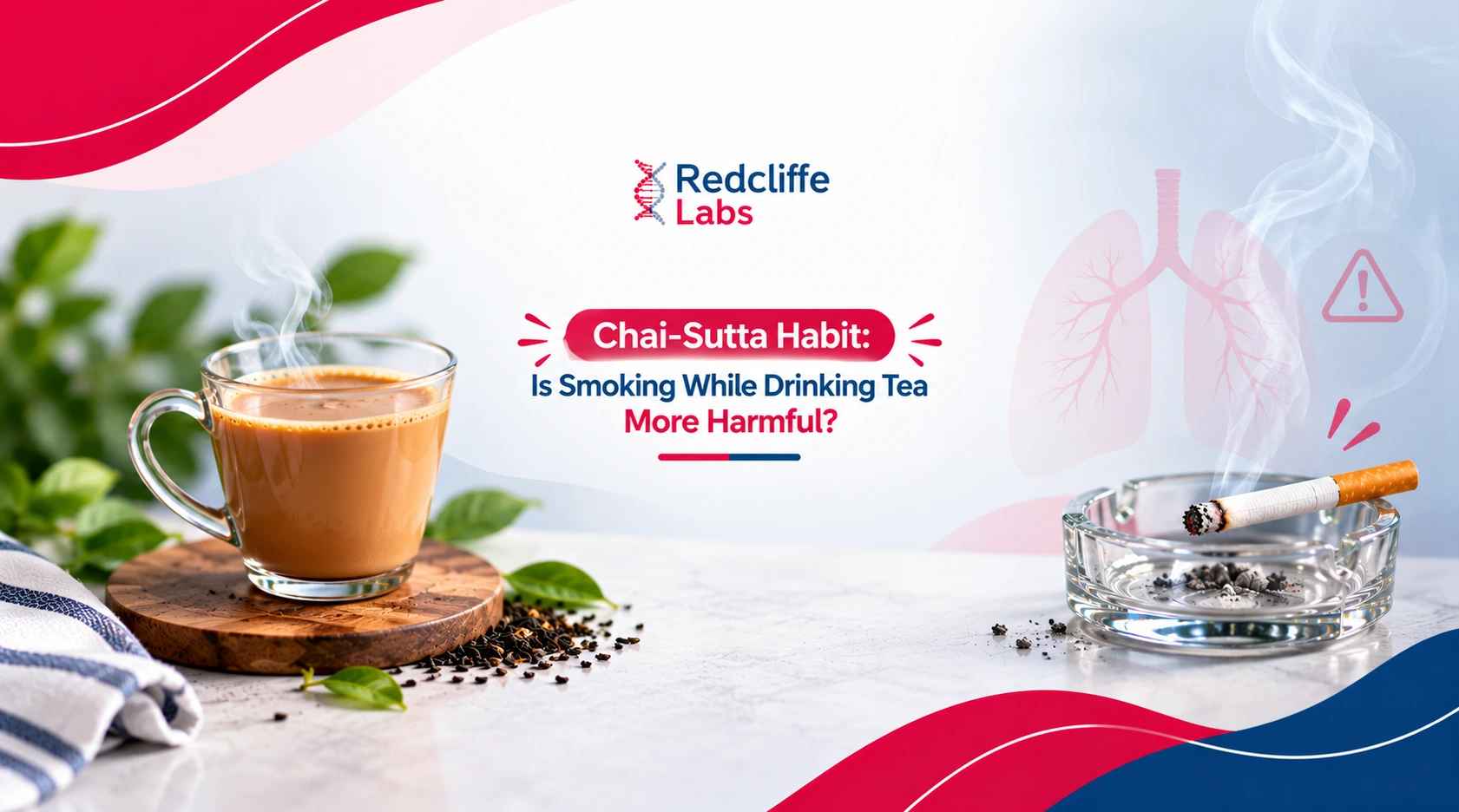
The chai-sutta habit means regularly pairing tea with a cigarette. Over time, the tea break, place, or company can become a reminder to smoke.
Smoking while drinking tea is harmful because smoking itself causes serious disease. Tea does not make cigarettes safe. The World Health Organization states that there is no safe level of tobacco exposure.
Is Smoking While Drinking Tea More Harmful Than Smoking Alone?
Current research does not clearly establish that an ordinary cup of warm tea makes each cigarette more harmful than smoking it alone. However, that does not make the combination safe.
Two concerns deserve attention:
- Tea temperature: Regularly drinking very hot beverages is linked with cancer of the oesophagus, the tube that carries food from your mouth to your stomach.
- The repeated routine: If every tea break brings a cigarette craving, the pairing can make quitting harder.
The studies discussed below examine drinking temperature and longer-term habits. They do not prove that taking a sip of chai and a puff at the same moment creates a special toxic reaction.
Milk tea, black tea, and green tea also cannot be relied on to protect you from cigarette smoke. Changing your drink does not remove smoking health risks.
What Are the Main Chai Sutta Health Risks?
The main proven risks come from smoking. Cigarette smoke contains chemicals that damage the body and cause cancer.
Smoking can affect:
- Your heart and blood vessels: It causes heart disease and stroke.
- Your lungs: It causes lung cancer and chronic obstructive pulmonary disease, or COPD. COPD is a long-term condition that makes breathing difficult.
- Other parts of your body: It causes several other cancers, including cancers of the mouth, throat, and food pipe.
Smoke also affects people nearby. A shared tea break should be free from second-hand smoke, which can cause heart and lung disease in people who do not smoke.
Also Read: How Does Smoking Affect Your Body? Effects on Major Organs
What Happens When Nicotine and Caffeine Are Used Together?
Nicotine in cigarettes and caffeine in tea can both stimulate the body. Small experiments suggest their short-term effects on blood pressure and other heart-related measures may add together.
However, these studies used controlled doses and methods. They cannot tell us exactly how much extra long-term risk comes from a typical chai-sutta break.
There is also a useful point to remember when quitting: caffeine stays in your body longer after you stop smoking. Your usual amount of tea may then leave you feeling more restless or make sleep harder. Try smaller cups, fewer cups, or less caffeine if this happens.
Can Smoking and Very Hot Tea Increase Food-Pipe Cancer Risk?
Smoking causes food-pipe cancer, and regularly drinking very hot beverages is a separate concern. Research has also found a link between high-temperature tea drinking alongside smoking or heavier alcohol use and a higher risk of this cancer.
The International Agency for Research on Cancer, or IARC, classifies drinking beverages above 65°C as “probably carcinogenic to humans.” In everyday words, the evidence suggests that regularly drinking beverages this hot can cause cancer. The concern is the temperature at which the drink is swallowed.
A 2018 study followed more than 450,000 adults in China. It found a higher risk of food-pipe cancer among people whose habits included high-temperature tea drinking together with smoking or heavier alcohol use. This was an observational study: researchers followed existing habits rather than assigning them. It cannot prove that smoking and drinking tea at the same moment caused the increased risk.
More recent research, published in September 2026, examined nearly one million UK adults. It linked a preference for very hot drinks with a higher risk of one type of food-pipe cancer, called squamous cell cancer. Drink temperatures were self-reported, so the findings still have limitations.
Let your chai cool until it is comfortable to sip. There is no fixed waiting time that works for every cup, and 65°C should not be treated as a precise boundary between safe and unsafe.
Why Does Drinking Tea Trigger Cigarette Cravings?
When you repeatedly smoke with tea, your brain can learn to connect the two. Eventually, the smell of chai, a familiar tea stall, or a particular group of friends may bring on a craving.
For example, if your afternoon break always means tea followed by a cigarette, you may find yourself reaching for the cigarette before you have even thought about it.
This learned connection can exist alongside nicotine addiction. It helps explain why changing the setting of a tea break can be useful when quitting. The National Cancer Institute specifically recommends changing tea or coffee routines that trigger smoking.
How Can You Break the Chai-Sutta Habit?
Start by changing the routine around tea and getting support for nicotine cravings. You do not have to manage both through willpower alone
- Choose a quit date. Plan for it by removing cigarettes, lighters, and ashtrays from the places where you usually take a break
- Move your tea break. Try a different place, sit with someone who does not smoke, or take your break at a different time.
- Have something ready for a craving. Sip water, chew sugar-free gum, breathe slowly, or take a short walk.
- Tell your usual tea companions. A simple “I’m quitting, so please don’t offer me a cigarette” can make the next break easier.
- Ask about treatment. A counsellor can help you plan for triggers and difficult days. A doctor or pharmacist can explain suitable quit-smoking medicines.
WHO recommends behavioural support and effective medicines for adults who want to quit smoking. Options include nicotine replacement therapy, such as patches or gum, and prescription medicines such as varenicline or bupropion. Combining support with medicine improves the chance of quitting successfully.
Nicotine replacement provides nicotine without the toxic mixture in cigarette smoke. Ask a healthcare professional how to use it correctly, especially if you are pregnant, breastfeeding, or have a significant medical condition.
Need help getting started? Call India’s toll-free National Tobacco Quitline on 1800-11-2356. Counselling is available in several Indian languages
What Smoking Withdrawal Symptoms Should You Expect?
Common smoking withdrawal symptoms include:
- Strong urges to smoke.
- Feeling irritable, anxious, or restless.
- Trouble concentrating.
- Changes in sleep.
- Feeling hungrier than usual.
Symptoms can begin within hours of the last cigarette. They are usually strongest during the first week, particularly the first three days, and often ease over the next three to four weeks. Some people need longer, and reminders such as a familiar tea break can bring back cravings later.
If withdrawal is making daily life difficult, ask for help with your quit plan. Support and suitable treatment can make the process more manageable.
Also Read: Smoking Withdrawal Symptoms: What to Expect After Quitting
What Health Checks Should Regular Smokers Consider?
Start with a medical assessment. There is no single set of “smoking tests” that can show all the harm cigarettes may have caused.
A doctor may ask how much you smoke, how long you have smoked, whether you have symptoms, and whether you have other health conditions. Blood pressure checks and an examination can help guide the next steps.
Depending on your age and other risk factors, cholesterol or blood sugar tests may be useful.
|
Test |
What it checks |
Preparation |
|
Cholesterol and triglycerides, which are fats in the blood. Results help assess heart disease risk alongside factors such as smoking and blood pressure. |
A blood sample is needed. Follow the laboratory’s fasting instructions. | |
|
Average blood sugar over roughly the past three months. It may help check for or monitor diabetes when appropriate. |
A blood sample is needed. Fasting is not required for HbA1c alone, but other tests booked with it may require fasting. |
Results need medical interpretation; some blood conditions can affect HbA1c.
Other assessments serve different purposes:
- Spirometry: A breathing test that may help investigate an ongoing cough, wheezing, or breathlessness.
- Low-dose CT screening: A lung scan for selected people at high risk of lung cancer. It is not recommended for every smoker. A doctor should discuss suitability, possible benefits, radiation exposure, and the chance of false alarms.
- Smoking Impact Assessment Profile: This is a basic assessment of smoking-related health risks. It covers CBC, BSR, HbA1c, GGT, and Vitamin D
- The Full Body Check-Up with Smoking Impact Assessment Profile: This is a comprehensive health screening that helps assess your overall health while also looking at how smoking may be affecting your body.
Normal blood results do not rule out lung disease or cancer, and they do not make smoking safe.
For convenient health monitoring, Redcliffe Labs offers a range of diagnostic tests with home sample collection, easy-to-understand reports, and access to expert consultations and AI-powered assistance. You can explore the available tests and choose the ones that best suit your healthcare needs.
Choose your city and confirm availability, preparation, and package contents before booking.
When Should You Seek Medical Advice?
Arrange a medical assessment if you have:
- A cough that does not go away or is getting worse.
- New or worsening breathlessness.
- Trouble swallowing.
These symptoms can have several causes. They do not automatically mean cancer, but they deserve attention.
Coughing up even small streaks of blood needs prompt medical advice. Seek emergency medical help if you cough up more than a few spots of blood, especially with chest pain or breathing trouble.
Severe difficulty breathing or a tight, heavy chest also needs emergency care. Do not wait for a health-check package or assume these symptoms are caused by withdrawal.
Make Your Next Tea Break a Step Towards Quitting
The clearest way to reduce chai sutta health risks is to stop smoking. Letting tea cool addresses the concern about very hot drinks, while changing your tea-break routine can help with the urge to light up.
Start with one practical step today: choose a quit date, tell someone who can support you, or call the quitline. Your tea break can still be a welcome pause in the day as you work towards making it smoke-free.
Frequently Asked Questions
1. Is one cigarette with my evening tea safe?
No amount of smoking is considered safe. Smoking less does not remove the risk, and even low levels of smoking can cause harm. If your cigarette use is occasional, it is still worth taking steps to stop.
2. How much gap should I leave between tea and a cigarette?
There is no evidence-based time gap that makes smoking safe. Waiting 10 or 30 minutes does not remove the risks from tobacco smoke. Let tea cool before drinking it, and work towards stopping cigarettes rather than relying on a gap.
3. Are bidis or hookah safer to have with chai?
No. Bidis and hookah are harmful tobacco products. Switching from cigarettes to another form of tobacco does not make the tea break safe or solve nicotine addiction.
4. Can I drink tea while using nicotine gum?
Avoid tea and other food or drinks for 15 minutes before using nicotine gum and while using it. Nicotine gum also needs to be used differently from ordinary chewing gum. Follow the product instructions and ask a pharmacist to explain the correct method.
5. Will my lungs recover after I quit smoking?
Yes, your lungs can start to recover after you quit smoking. Over time, you may notice less coughing, easier breathing, and improvements in lung function. Quitting also lowers your risk of developing smoking-related diseases. However, if smoking has already caused serious lung damage, some of it may not fully heal. The good news is that quitting smoking is beneficial at any stage, even if you have smoked for many years.
6. What if I smoke once after quitting?
Smoking one cigarette after quitting doesn’t mean you have failed or have to start over. The important thing is to stop there and get back to your plan to quit smoking. If you find it hard to resist the urge to smoke, talk to a healthcare professional for support.