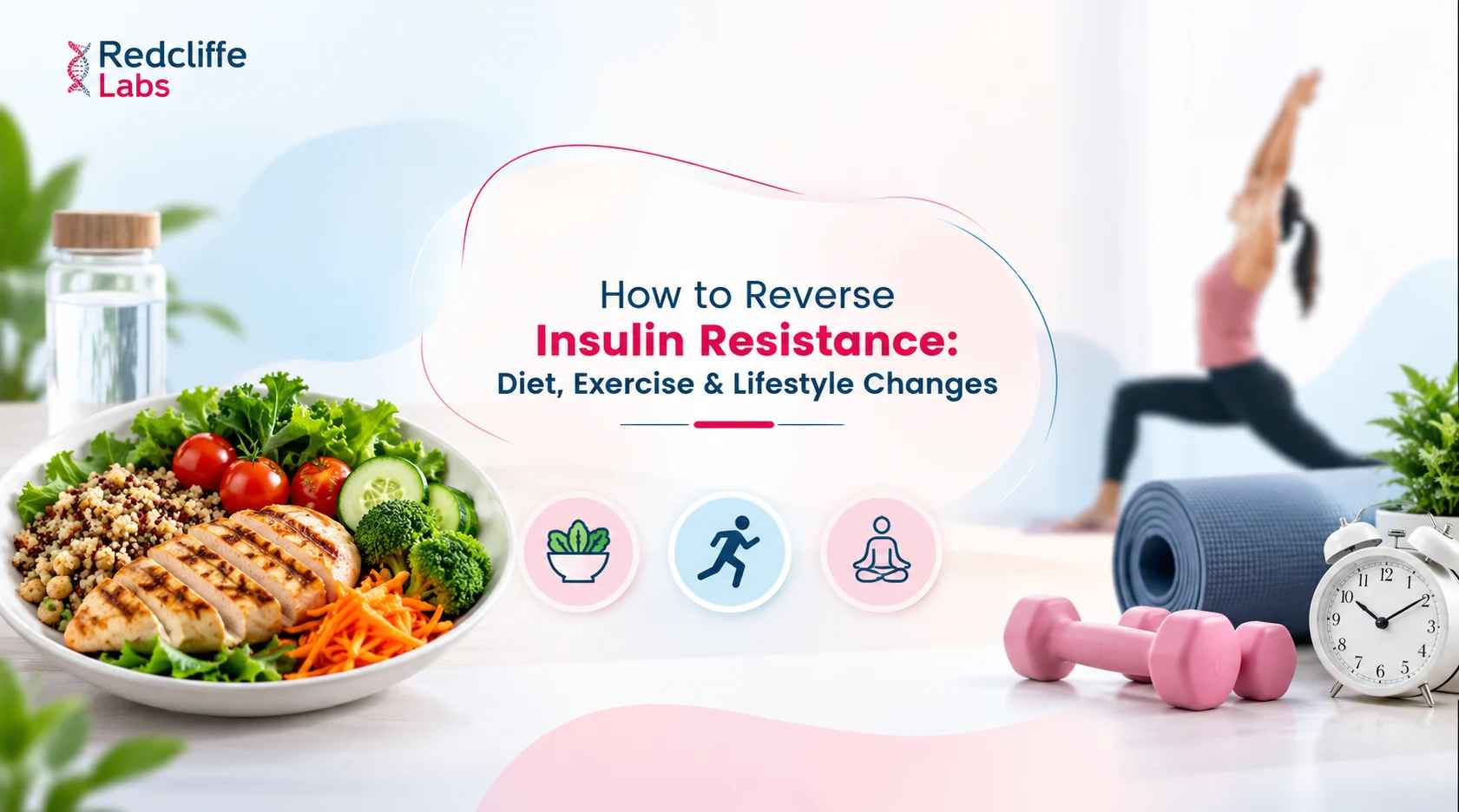
How to Reverse Insulin Resistance: Diet, Exercise & Lifestyle Changes

Overview:
- Insulin resistance can often be improved with consistent changes in diet, physical activity, weight management when appropriate, sleep, and overall lifestyle.
- There is no guaranteed 30-day cure for insulin resistance. The timeline for improvement varies from person to person.
- A balanced diet can include carbohydrates. Focus on better-quality carbohydrates, appropriate portions, fibre, protein, and minimally processed foods.
- Regular aerobic activity and resistance training can improve insulin sensitivity.
- For people with overweight or obesity, even 5–7% weight loss can improve metabolic markers and provide health benefits.
- Tests such as fasting insulin, fasting blood sugar, HbA1c, and HOMA-IR may be useful in different situations, but there is no single universal test that confirms insulin resistance in everyone.
Imagine your body’s cells as a cozy home, glucose (sugar) as a guest trying to bring in energy, and insulin as the key that unlocks the front door. When you have insulin resistance, it’s like the keyholes have gotten rusty; the keys don't work as smoothly as they used to, so your body has to work overtime, making more and more keys (insulin) just to let energy in. Over time, this extra effort can make you feel fatigued, cause weight fluctuations, and raise your risk for prediabetes or type 2 diabetes.
The good news? You can help fix those rusty locks naturally! You don't need extreme starvation diets or magic pills to turn things around. By making simple, enjoyable, and sustainable upgrades to your food, movement, and daily routine, you can boost your insulin sensitivity and feel like your vibrant self again.
What Is Insulin Resistance?
When you eat, your digestive system breaks carbohydrates down into glucose, which enters your bloodstream. Your pancreas releases insulin to help muscle, fat, and liver cells absorb that glucose and turn it into fuel.
When cells stop responding effectively to insulin, the pancreas produces extra insulin to compensate. If this cycle continues, blood sugar levels can eventually rise.
Key factors linked to insulin resistance include:
- Extra body fat (especially around the midsection)
- Physical inactivity
- Family history
- Hormonal conditions such as PCOS
Early on, insulin resistance rarely shows obvious symptoms. However, with consistent habit changes, your body can regain its efficiency.
Can Insulin Resistance Be Reversed?
Insulin resistance can often be improved, and in some people it can substantially decrease with lifestyle changes. However, there is no universal cure or fixed timeline. What works depends on why insulin resistance developed, your current metabolic health, medications, activity level, body composition, and other health conditions.
For people at high risk of type 2 diabetes, structured lifestyle interventions involving healthier eating, physical activity, and weight management can reduce the risk of developing diabetes.
It helps to shift the mindset from asking, "How fast can I cure this?" to asking, "What small, positive changes can I maintain every day?"
Curious about your risk?
Check out the Pre-Diabetic Calculator for a quick awareness check. (Note: It's an awareness tool and doesn't replace a doctor's evaluation.)
How to Reverse Insulin Resistance Naturally?

Improving your insulin response isn't about eliminating everything you love; it’s about creating a colorful, balanced pattern of healthy choices.
1. Upgrade Your Plate with Real, Whole Foods
Build your meals around satisfying, nutrient-rich choices:
- Plenty of Non-Starchy Vegetables: Spinach, broccoli, peppers, cauliflower
- Whole Fruits: (add fruits that are low in GI) Apples, berries, guavas, oranges
- Quality Proteins: Dal, beans, eggs, paneer, tofu, chicken, fish
- Fibre-Rich Carbohydrates: Oats, brown rice, whole wheat roti, legumes
- Healthy Fats & Seeds: Almonds, walnuts, chia seeds, flaxseeds
2. Don't Eliminate Carbohydrates Automatically
One common misconception is that you must stop eating carbohydrates to reverse insulin resistance.
You do not need to cut out carbs entirely. Rice, roti, oats, and fruit can all fit into a healthy lifestyle. What matters most is:
- Choosing minimally processed whole grains over refined carbohydrates.
- Keeping portion sizes realistic.
- Pairing your carbs with protein and healthy fats to prevent sharp blood sugar spikes.
For example, dal, vegetables, salad, curd, and a moderate portion of roti provide a different meal pattern from a plate containing a large amount of carbs or fried food like rice and bhature with minimal fibre and protein, along with it.
3. Eat More Fibre-Rich Foods
Fibre acts like a gentle brake on digestion, helping you stay full longer and smoothing out energy levels after meals. Aim to gradually increase fibre through food sources, including:
- Vegetables
- Whole fruits
- Oats
- Whole grains
- Dal
- Chickpeas
- Rajma
- Beans
- Nuts and seeds
Increase fibre gradually if your current intake is low and maintain adequate fluid intake.
4. Reduce Sugary Drinks and Refined Foods
Start by reducing foods and drinks that provide large amounts of added sugar or refined carbohydrates with relatively little nutritional value. Swap them for infused water, unsweetened herbal teas, or whole fruit when a sweet craving strikes.
Examples include:
- Soft drinks
- Sweetened fruit drinks
- Sugary tea and coffee
- Sweets
- Biscuits
- Cakes and pastries
- Highly refined packaged snacks
You don't need to completely overhaul your diet overnight. Small changes that you can maintain are more useful than an extreme diet that lasts only a few weeks.
Insulin Resistance Diet Plan: What to Eat in a Day
There is no single insulin resistance diet plan that works for everyone. The goal is to build balanced meals with adequate protein, fibre and healthy fats while choosing minimally processed carbohydrates and limiting sugary drinks and refined foods.
For some people, small, balanced meals spaced throughout the day may be easier to manage than very large meals with long gaps between them.
The right meal pattern should also take into account your nutritional needs, medications, activity level, food preferences, and health conditions.
Sample 1-Day Insulin Resistance Diet Plan
|
Time |
Meal |
Example |
Why it helps |
|
On waking |
Hydration |
Methi (fenugreek) water or plain water |
Supports hydration; methi water should not be considered a treatment for insulin resistance. |
|
Breakfast |
High-protein + fibre |
Unrefined/whole oats cooked with vegetables + eggs, paneer, tofu or unsweetened curd |
Protein supports fullness, while fibre-rich oats and vegetables provide slower-digesting carbohydrates. |
|
Mid-morning |
Fruit + healthy fats |
One low-GI fruit such as guava, apple, pear or orange + a small handful of almonds, walnuts or seeds |
Combining fruit with nuts/seeds adds protein, fibre and healthy fats to the meal. |
|
Lunch |
Balanced meal |
½ plate cooked non-starchy vegetables and salad + ¼ plate dal/chole/rajma/chicken/fish + ¼ plate roti or brown rice |
Combines fibre, protein and controlled carbohydrates for a more balanced meal. |
|
Evening |
Small balanced meal |
Roasted chana + unsweetened curd, or sprouts/vegetable chaat with a small portion of nuts or seeds |
Provides a nutrient-dense option instead of refined snacks and helps avoid very large meals later. |
|
Dinner |
Balanced Meal |
Cooked Mixed vegetables + Salad dal/soya/ paneer/tofu/egg/ chicken/fish+ a moderate portion of roti or another minimally processed whole-grain carbohydrate |
Provides protein and fibre while keeping the carbohydrate portion balanced. |
|
After dinner |
Unsweetened herbal tea |
Chamomile, spearmint or another caffeine-free herbal tea without added sugar |
A sugar-free option if you want a warm drink after dinner. |
Simple Rules for an Insulin Resistance Diet:
- Include protein with main meals such as dal, beans, rajma, chole, besan, chana, soy, eggs, curd, paneer, tofu, fish, and lean meats to help make meals more balanced and filling.
- Make vegetables a regular part of lunch and dinner. Choose a variety of non-starchy vegetables and salad rather than relying mainly on refined carbohydrates.
- Choose whole and minimally processed carbohydrate sources more often. Choose options such as millets (ragi, jowar, bajra), whole oats, whole-wheat roti and multigrain rotis made with whole grains. Legumes, vegetables and whole fruits also provide carbohydrates along with fibre and other nutrients. When choosing packaged multigrain products, check that they contain whole grains rather than mainly refined flour (maida).
- Pair carbohydrates with protein and fibre. For example, choose whole fruit instead of juice and combine carbohydrate foods with protein- or fibre-rich foods.
- Limit sugary drinks, Diet Coke, and frequent refined snacks. Don't skip meals simply to “keep insulin low.” Meal timing should be individualized, particularly if you take glucose-lowering medication or have another medical condition.
What About Diet Coke and Zero-Sugar Drinks?
If you're trying to reduce your intake of sugary or sweetened beverages, you don't have to rely on zero-sugar soft drinks. Try naturally refreshing alternatives such as:
- Plain or sparkling water with lemon, lime or mint
- Infused water with cucumber, lemon, mint, orange or berries
- Unsweetened coconut water in an appropriate portion
- Unsweetened herbal teas such as chamomile, spearmint or green tea
These options can add variety to your day without making sweetened soft drinks a regular part of your routine. Water should remain your main beverage, while coconut water and other naturally carbohydrate-containing drinks are best consumed in appropriate portions.
How to Lower Insulin Resistance Through Exercise?
Exercise is one of the most practical ways to lower insulin resistance and improve insulin sensitivity.
You don't need a complicated workout routine.
A combination of:
- Aerobic activity
- Resistance training
- Regular daily movement
- Less prolonged sitting
can form the foundation of an active lifestyle.
1. Aerobic Exercise
Examples include:
- Brisk walking
- Cycling
- Swimming
- Jogging
- Dancing
- Other activities that increase your heart rate
For adults at increased risk of type 2 diabetes, at least 150 minutes of moderate-intensity physical activity per week is a commonly recommended target.
You can divide this into shorter sessions across the week rather than trying to complete it all at once.
2. Resistance Training
Strength training can help build and maintain muscle and should be part of a well-rounded exercise routine.
Examples include:
- Squats
- Lunges
- Push-ups
- Resistance-band exercises
- Free weights
- Weight machines
- Bodyweight exercises
If you are new to exercise or have a medical condition, start gradually and choose activities appropriate for your fitness level.
Does Walking Help Reduce Insulin Resistance?
Yes. Walking is a practical form of physical activity that can contribute to better insulin sensitivity and metabolic health.
Brisk walking can count toward your weekly moderate-intensity activity target. Regular movement is particularly useful if much of your day is spent sitting.
The goal is not to find a special “insulin resistance walk.” The benefit comes from making physical activity a consistent part of your routine.
How to Reverse Insulin Resistance in 30 Days: What Can Actually Change?
If you're searching for how to reverse insulin resistance in 30 days, it's important to set realistic expectations.
There is no guaranteed 30-day cure for insulin resistance. However, 30 days can be enough to establish habits that support better metabolic health.
A practical 30-day starting plan
Week 1: Improve your meals
- Replace sugary drinks with water or unsweetened beverages.
- Add vegetables to lunch and dinner.
- Choose whole fruit instead of juice.
- Include protein with main meals.
Week 2: Increase movement
- Start regular walking.
- Reduce long periods of sitting.
- Gradually work toward your weekly activity target.
Week 3: Add strength training
- Introduce resistance exercises appropriate for your fitness level.
- Aim for consistency rather than intense workouts.
Week 4: Make the routine sustainable
- Review which habits were easiest to maintain.
- Adjust meals according to your schedule and preferences.
- Maintain regular sleep and activity patterns.
- Continue rather than treating day 30 as the finish line.
Some metabolic measurements can change over weeks, but there is no single timeline for everyone. HbA1c, for example, reflects average blood glucose over roughly the previous 2–3 months, so it isn't an ideal marker for judging the full effect of a few days of lifestyle changes.
Thirty days should be viewed as a starting point, not a deadline for a cure.
Does Weight Loss Help Reverse Insulin Resistance?
For people with overweight or obesity, weight loss can improve metabolic health and glucose regulation.
A weight reduction of 5–7% can provide metabolic benefits for people at increased risk of type 2 diabetes, while greater sustained weight loss may provide additional benefits.
However, this does not mean that everyone with insulin resistance needs to lose weight. Insulin resistance can occur at different body sizes, and weight management should be individualized.
The goal should be improving overall metabolic health rather than pursuing rapid weight loss at any cost. (Check your baseline with this BMI Calculator)
Can Sleep and Stress Affect Insulin Resistance?
Food and exercise aren't the only parts of metabolic health. Poor sleep, chronic stress, and irregular routines can make it harder to maintain healthy eating and physical activity habits.
Try to:
- Maintain a regular sleep and wake schedule
- Get adequate sleep
- Take movement breaks during long periods of sitting
- Maintain consistent meal and activity routines
- Use stress-management techniques that you can realistically continue
Think of these habits as supporting the bigger lifestyle picture rather than as a quick fix for insulin resistance.
Also Read:
https://redcliffelabs.com/myhealth/health/how-stress-affects-your-insulin-sensitivity/
Insulin Resistance Supplements: Do They Work?
Searches for insulin resistance supplements and supplements to reverse insulin resistance are common, but supplements should not be treated as a universal solution.
Some vitamins, minerals, and herbal products have been studied for metabolic health, but evidence varies, and supplements can interact with medicines or be inappropriate for certain health conditions.
If you are considering a supplement, discuss it with a healthcare professional before taking it regularly.
No supplement should replace a balanced eating pattern, physical activity, or prescribed treatment.
When Should You Get Tested for Insulin Resistance?
Consider discussing metabolic testing with a healthcare professional if you have risk factors such as:
- Prediabetes or previously abnormal blood glucose
- Family history of type 2 diabetes
- Overweight or obesity
- Increased waist circumference
- Physical inactivity
- PCOS
- High blood pressure
- Abnormal cholesterol or triglycerides
- Previous gestational diabetes
- Other conditions associated with insulin resistance
Testing decisions should be based on your age, medical history, symptoms, and individual risk.
Want a comprehensive overview of your wellness? Try the Health Risk Assessment tool as a starting guide alongside professional medical advice.
What Is an Insulin Resistance Test?
There is no single universally accepted routine test that independently confirms insulin resistance in every person.
Different tests provide different information.
|
Test |
What it assesses |
|
Fasting Insulin |
Measures insulin levels after fasting and may provide information about insulin response when interpreted with other results. |
|
Fasting Blood Sugar (FBS) |
Measures blood glucose after fasting and helps assess glucose regulation. |
|
HbA1c |
Estimates average blood glucose over approximately the previous 2–3 months and is commonly used to identify prediabetes and diabetes. |
|
HOMA-IR |
An estimate calculated using fasting insulin and fasting glucose that may be used to assess insulin resistance. |
|
Lipid Profile |
Measures cholesterol and triglycerides and can help assess broader cardiometabolic risk. |
Which Tests and Packages May Help Assess Metabolic Health?
Depending on your health history and the tests recommended by your healthcare professional, metabolic assessment may include:
For broader screening, relevant diagnostic packages may include:
The appropriate test or package depends on what you are trying to assess. A package is not automatically better than an individual test; the choice should match your symptoms, risk factors, and clinical needs.
Takeaway:
Reversing insulin resistance is a journey of self-care, not a quick fix. Focus on adding nutritious foods, moving your body with joy, getting restful sleep, and staying consistent. Every small step you take today helps unlock your energy for tomorrow!
Frequently Asked Questions
- Can I eat rice and roti if I have insulin resistance?
Yes! You don't need to eliminate them. Focus on portion control, choosing whole-grain options where possible, and combining them with protein and vegetables.
- Do insulin resistance supplements work?
Supplements are not a replacement for healthy food and exercise. Some vitamins or minerals are studied for metabolic health, but always consult your doctor before taking any supplements, as they can interact with medications.
- How long does it take to see results?
Energy levels and post-meal blood sugar often improve within weeks of consistent lifestyle changes. Key markers like HbA1c reflect changes over 2–3 months.
- How can I reverse insulin resistance naturally?
You can support better insulin sensitivity by eating mostly minimally processed foods, increasing vegetables and fiber, exercising regularly, including resistance training, managing weight when appropriate, and getting adequate sleep. There is no single food or home remedy that reverses insulin resistance.
- How can I reverse insulin resistance in 30 days?
There is no guaranteed 30-day reversal. However, 30 days can be enough to establish healthier eating, exercise, sleep, and activity habits that support better metabolic health over time.
- How can I lower insulin resistance?
Focus on regular physical activity, a nutrient-dense eating pattern, adequate fibre, appropriate weight management, good sleep, and reduced sedentary time. If another health condition is contributing to insulin resistance, treating it may also be important.
- What foods are best for insulin resistance?
Emphasize vegetables, whole fruits, legumes, whole grains, protein-rich foods, nuts, seeds, and other minimally processed foods. Limit sugary drinks, sweets, refined grains, and highly processed foods more often.
- Do I need to stop eating rice and roti?
Not necessarily. Portion size, carbohydrate quality, and the rest of the meal matter. Rice or roti can be included as part of a balanced meal based on your individual nutritional needs.
- What are insulin resistance symptoms in females?
Insulin resistance often has no obvious symptoms. Some women may have associated features such as increased waist circumference, acanthosis nigricans, irregular periods, or PCOS-related symptoms, but these do not confirm insulin resistance on their own.
- What is the best insulin resistance test?
There is no single universally accepted test for everyone. Fasting insulin, fasting glucose, and HOMA-IR may provide information about insulin resistance, while HbA1c and glucose testing are important for assessing prediabetes and diabetes.
- How long does it take to reverse insulin resistance?
There is no fixed timeline. Some metabolic changes can occur within weeks, while meaningful improvement may take several months or longer. The underlying cause, starting health status, and consistency of lifestyle changes all matter.
- Can insulin resistance be permanently reversed?
It can be substantially improved in many people, but there is no guarantee of permanent reversal. Long-term lifestyle habits and appropriate medical management remain important.