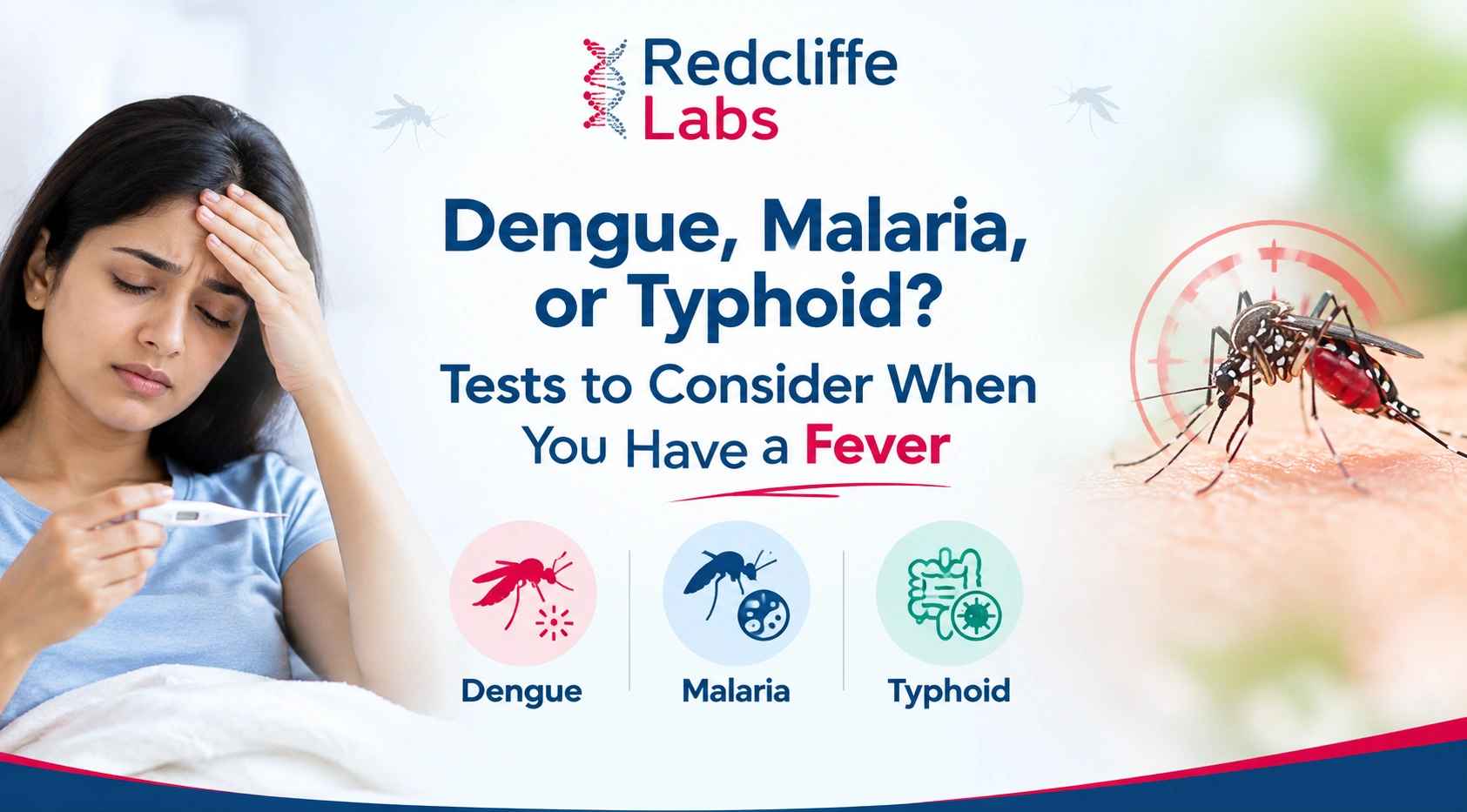
Dengue, malaria, or typhoid? Tests to Consider When You Have a Fever

Rather than just asking, "How high is my fever?"
Ask what might be causing it.
A body temperature of 101°F or 103°F indicates a fever, but it doesn't show whether the cause is dengue, malaria, typhoid, or another infection. The National Center for Vector-Borne Disease Control (NCVBDC), which is part of the Ministry of Health & Family Welfare in India, reported 233,519 cases of dengue in 2024, while malaria surveillance found 255,500 positive cases after testing over 181 million people.
The data show that clinicians should not diagnose persistent fever based on symptoms alone. This is because dengue, malaria, and typhoid can all begin with the same signs; therefore, laboratory testing is important. Tests including the dengue NS1 test, the dengue IgM test, the malaria parasite smear, the malaria antigen tests, and a blood culture for typhoid help establish the true cause and enable timely care.
Also Read: Chills with Fever: What It Means, When to Worry, and What to Do
Fever With No Clear Cause? Start With the Basics
A fever is merely an indication, not a disease itself. Your body temperature may rise because of infections, inflammation, heat exposure, certain medications, and other conditions. If a fever is associated with chills, severe weakness, headache, vomiting, abdominal discomfort, body pain, or other unusual symptoms, a doctor may investigate whether an infectious cause is responsible.
In India, dengue, malaria, and typhoid should be considered as three major possibilities in the right clinical situation. Yet they are by no means the only causes of fever; chikungunya, influenza, COVID-19, urinary infections, respiratory infections, and other illnesses can also produce similar symptoms.
The essential question is this: "Which fever do I have?"
It is: "What kind of information will help me to identify the cause of my fever?"
That's when laboratory testing becomes useful.
Symptom Breakdown: How to Tell the Difference
Although all three conditions cause fever and body pain, each disease provides different signs. Quick Fact: A fever can look similar on the outside while the cause is completely different. Quick Fact: A fever can look similar on the outside while the cause is completely different on the inside. That is one reason laboratory confirmation is valuable before starting disease-specific treatment. Here are the following fever tests that you should know: Dengue testing depends heavily on when the sample is collected. The virus, its viral proteins, and antibodies appear at different stages of infection, so a test useful in the first few days might not be the best one to rely on later. The NS1 antigen test detects a protein that is produced by the dengue virus. It is especially useful in the acute stage of the illness. According to CDC guidance, NS1 antigen testing should be done during the first seven days of illness, generally alongside an IgM antibody test, depending on the clinical situation. A positive NS1 test supports a diagnosis of acute dengue, while a negative result does not completely exclude dengue. When might a doctor consider it? The immune system produces an antibody known as IgM in response to an infection. The CDC (Centers for Disease Control and Prevention) states that dengue IgM usually becomes detectable between days 4 and 5 and is most useful as the disease progresses; after day 7, it becomes the main serological test when it is appropriate. Together, the Dengue IgG and IgM antibody tests can provide information about dengue antibodies. However, IgG has an important limitation: a positive IgG result alone does not always indicate an acute dengue infection, since previous exposure can cause IgG antibodies to remain. Book a Dengue IgM Antibody Test Quick Fact Dengue testing is not just classified as "positive or negative," and the day on which the illness occurs can affect which test gives the most useful information. Malaria differs from dengue because a parasite, not a virus, causes it. The parasite enters the bloodstream and infects red blood cells. Because malaria can become serious, especially with Plasmodium falciparum, prompt diagnosis is important. WHO recommends using microscopy or a malaria rapid diagnostic test (RDT) for people suspected of having malaria before administering antimalarial treatment. The peripheral smear for the malaria parasite, often referred to as a malaria parasite smear, involves examining blood under a microscope to look for malaria parasites. It can identify malaria parasites and may provide information about the species that caused the infection and the parasite burden. Why is a blood smear useful? The World Health Organization describes microscopy as a major method for diagnosing malaria and recommends examining both thick and thin blood films to achieve good parasite detection and identification. A malaria rapid diagnostic test finds certain proteins, called antigens, made by malaria parasites. These tests provide results quickly and are especially useful when high-quality microscopy is not readily available. The World Health Organization observes that malaria rapid diagnostic tests typically use blood and detect antigens associated with various Plasmodium species, depending on the test used. Quick Fact A malaria test is not just a 'fever test' because it detects the parasite or its antigens, which is why parasite-based confirmation matters. The bacterium Salmonella Typhi causes typhoid fever, while the related Salmonella Paratyphi bacteria cause paratyphoid fever. Typhoid differs from dengue and malaria in that mosquitoes do not spread it, and the infection is usually linked to contaminated food or water. Its symptoms can be confused with a great many other febrile illnesses. The World Health Organization's 2026 laboratory manual states that enteric fever can be hard to distinguish clinically from diseases such as dengue and malaria, which is why an accurate laboratory diagnosis is important. Persistent fever, headache, stomach pain, and unusual weakness? So don't ignore the signs. Typhoid can spread through contaminated food or water, and early testing can help identify a recent infection. The Typhoid (Typhidot) Test IGM This test detects antibodies produced early during infection, helping doctors assess possible acute typhoid and guide timely treatment. Typhoid can begin with symptoms that seem like a normal fever, but early diagnosis matters. The Typhidot IgM and IgG test checks antibodies against Salmonella typhi, helping doctors determine whether an infection is recent or past. A simple blood sample can provide useful information for timely medical care. If you have a persistent fever or related symptoms, don't ignore them. Book your Typhoid (Typhidot). Test IgG & IgM The Widal test detects antibodies directed against Salmonella antigens. It remains widely available and is commonly used in India, including by diagnostic laboratories, and Redcliffe Labs provides the Widal test as a blood test. Nevertheless, there is a significant difference between being available and being the preferred confirmatory test. The CDC does not recommend the Widal test because it has a high rate of false-positive results and maintains that blood culture is the method of choice for diagnosing acute typhoid. Quick Fact A Widal test result that is positive should not be regarded as conclusive proof of having typhoid. The doctor will consider the result in light of the symptoms, the length of the illness, the patient's exposure history, and other laboratory findings. There is no single best fever test for all cases. The appropriate investigation depends on what the doctor thinks and how long you have been unwell. If the concern is... Tests doctors may consider Why Dengue during early fever NS1 antigen ± IgM Detects dengue-related antigen/antibodies during the acute phase Dengue after the early phase IgM and other tests as clinically indicated Antibodies become increasingly useful Malaria MP smear and/or malaria antigen RDT Looks for parasite or parasite antigen Typhoid Blood culture Preferred method for identifying Salmonella Typhoid where culture is not immediately available Widal or other tests as advised May provide supportive information but has limitations Unexplained persistent fever Additional tests based on clinical assessment Fever can have many causes beyond these three The table is a guide, not a set of instructions. A doctor might suggest more than one test because infections can overlap, and symptoms alone are not specific enough. When someone has a fever, many people quickly turn to antibiotics or medicines suggested by friends and relatives. That can create problems. A virus causes dengue, whereas malaria and typhoid have entirely different causes. You should not therefore automatically apply the treatment for one of these to the others. Antibiotics are not effective against dengue, and using them when they are not needed can lead to antimicrobial resistance and make it harder to assess the patient later. Similarly, use antimalarial medicines only after proper clinical and diagnostic checks. The simplest approach is to identify the cause before deciding what to take. Although dengue, malaria, and typhoid can present with similar symptoms, the right test can determine the exact cause. For dengue, NS1 or antibody testing is needed; for malaria, parasite-based testing is required; and for typhoid, blood culture is the preferred method. It is also important to consider when the test is carried out, so always follow your doctor's advice. If you want a reliable and convenient way of getting your tests done, Redcliffe Labs is a sensible option. It provides free consultations with both a doctor and a dietitian to help you understand your results and feel more confident about what to do next. Rather than trying to work out your own fever or taking medication on your own, get the correct test, understand the results, and obtain proper medical advice. If a fever continues, finding out what is causing it should be the first step toward getting the right kind of care. The appropriate dengue test varies depending on how many days you have had a fever. In the first few days, the Dengue NS1 antigen test may help detect the infection, while after about 4 to 5 days, the Dengue IgM antibody test becomes more useful. Your doctor will likely suggest one or more of these tests depending on your symptoms and how long you've been ill. You cannot reliably tell from the symptoms alone whether you have dengue, malaria, or typhoid since the symptoms may overlap. A doctor might look at your fever pattern, symptoms, and travel and exposure history before suggesting blood tests. Testing for dengue, the malaria parasite, and typhoid can help establish the probable cause. The choice of tests depends on the person's symptoms and the suspected cause of the fever. The doctor might recommend a CBC, a dengue NS1 or antibody test, a malaria parasite smear, a malaria antigen test, or typhoid investigations. In some cases, other tests such as a CRP test, a liver function test, or a urine test may also be suggested to identify the cause. A CBC cannot directly confirm dengue or malaria; instead, it looks at blood components such as hemoglobin, white blood cells, and platelets, which can change during infection. Doctors can use CBC results alongside disease-specific tests; for dengue, appropriate antigen or antibody testing is required, and for malaria, parasite-based testing or a suitable rapid diagnostic test is needed. Tests can detect the virus or the body's immune response. NS1 antigen testing is useful at the beginning of the illness, while IgM antibody testing becomes more useful as the illness progresses. The tests doctors recommend depend on how many days have passed since the fever started. Malaria can be diagnosed with blood tests that detect the parasite. In a malaria parasite smear, the blood is examined under a microscope to spot Plasmodium parasites. A malaria rapid diagnostic test can identify antigens associated with the parasite. The decision on which test to use is based on availability, symptoms, and medical assessment. When malaria is suspected, testing should be carried out as soon as possible and not delayed. Blood culture is the test of choice for confirming typhoid fever because it can detect Salmonella Typhi or related bacteria in a blood sample. Widal testing is also available and widely used, but it does have limitations and may lead to misleading results. For this reason, a Widal result must be interpreted with care, taking into account the patient's symptoms and medical history. Not at all. Different organisms cause dengue and malaria, so they require different diagnostic methods. For dengue, testing can be done with either an NS1 antigen test or an antibody test, whereas parasite smears or appropriate rapid antigen tests detect malaria. In both cases, examinations can be done using blood samples if a doctor suspects one of these infections. Dengue testing can begin early in the fever. NS1 antigen testing is particularly useful during the first week, while IgM antibodies generally become detectable around days 4–5 and become more useful later. The best test depends on your illness day, symptoms, and doctor's assessment, so avoid choosing a test based on timing alone. As soon as possible, rather than waiting several days, you should get a medical evaluation if malaria is suspected. A malaria parasite smear or a rapid diagnostic test may be used to detect the infection, and you should let your doctor know when the fever began, whether you have had chills or sweating, and whether you have recently traveled or spent time in a malaria-prone area. You should not wait a specific number of days with a fever before contacting a doctor. If typhoid is suspected, get a medical evaluation as early as possible. Although a blood culture is the preferred diagnostic test, its usefulness can be affected by prior antibiotic treatment. Your doctor will determine the right time for testing according to your symptoms and medical history. Dengue commonly causes sudden fever, headache, body aches, nausea, and sometimes rash. Malaria may cause fever with chills, sweating, headache, and weakness. Typhoid can cause a gradually increasing fever, weakness, headache, and digestive symptoms. However, these symptoms can overlap, so testing is often needed to identify the actual cause of fever.Symptom / Marker Dengue (Viral) Malaria (Parasitic) Typhoid (Bacterial) Eye Pain Severe Mild None Chills & Sweats Moderate Extreme Moderate GI Distress Mild Mild Severe Platelet Drop Severe Moderate None Common Fever Tests: Dengue, Malaria, and Typhoid
1. Dengue Tests: Which One Is Useful and When?
Dengue NS1 Antigen Test
Dengue IgM Antibody Test
Dengue IgG and IgM Tests
2. Malaria Tests: Looking for the Parasite
Malaria Parasite (MP) Smear
Malaria Antigen Rapid Test
3. Typhoid Tests: Why Blood Culture Matters
Typhoid (Typhidot) Test IGM
Typhoid (Typhidot) Test IgG & IgM
What About the Widal Test?
Dengue, Malaria, or Typhoid: Which Test Should You Consider?
Why Self-Medication Can Be a Problem
The Bottom Line: Don't Guess the Fever
FAQs
Which test is best for dengue fever?
How do I know if I have dengue, malaria, or typhoid?
What blood tests are done for fever?
Can a CBC test detect dengue or malaria?
What test confirms dengue fever?
Which test is used to diagnose malaria?
What test confirms typhoid fever?
Can dengue and malaria be detected through the same blood test?
When should I get tested for dengue after a fever starts?
When should I get a malaria test after developing a fever?
How many days of fever before getting a typhoid test?
What is the difference between dengue, malaria, and typhoid symptoms?