Female Hormone Test List: A Complete Guide to Women’s Hormonal Health

Medically Reviewed By
Dr. Mayanka Lodha Seth
Written By Sheena Mehta
on Jan 27, 2026
Last Edit Made By Sheena Mehta
on Feb 2, 2026
Hormones play a crucial role in regulating a woman’s overall health, influencing menstrual cycles, fertility, pregnancy, metabolism, mood, bone strength, and menopause. Even a slight hormonal imbalance can lead to noticeable physical and emotional changes. A female hormone test helps evaluate these hormone levels and detect underlying health conditions at an early stage.
Hormonal changes typically begin between the ages of 10 and 13, marking the onset of puberty and significant physical and emotional development. This maturation process continues through adolescence and into the early 20s.
During this period, fluctuations in estrogen and other hormones may influence mood and emotional well-being, highlighting the importance of monitoring hormonal health across different life stages.
Today’s blog is a comprehensive guide that provides a complete and accurate list of female hormone tests, explaining the purpose, normal role, and clinical importance of each test.
What is a Female Hormone Test?
A female hormone test is a blood, urine, or saliva test used to measure hormone levels that control reproductive health and other essential body functions.
Doctors recommend these tests to assess menstrual irregularities, infertility, PCOS, menopause, thyroid disorders, unexplained weight changes, mood swings, and abnormal hair growth.
When Should Women Get Hormone Tests?
Women may need hormone testing if they experience:
- Irregular periods
- Difficulty conceiving
- Excessive hair growth or hair loss
- Planning pregnancy or fertility preservation
- Acne
- Mood swings or depression
- Hot flashes or night sweats due to perimenopause or menopause
- Unexplained weight changes
- Early or delayed onset of puberty
Female Hormone Testing: Navigating Hormonal Changes with a Comprehensive Test List
A comprehensive female hormone test list may include key hormone markers like:
1. Estrogen (Estradiol- E2) Test
Estrogen is the main female sex hormone responsible for the development of reproductive organs, the regulation of the menstrual cycle, bone density, and cardiovascular health.
Why it is done:
- Irregular or missed periods
- Infertility evaluation
- Menopause assessment
- Ovarian function monitoring
Low Levels May Indicate:
- Menopause or ovarian failure
- Poor ovarian function
- Eating disorders or excessive exercise
High Levels May Indicate:
- Polycystic Ovary Syndrome (PCOS)
- Estrogen-producing tumors
- Liver dysfunction
2. Progesterone Test
Progesterone is essential for preparing the uterus for pregnancy. It also supports implantation and maintains early pregnancy by aiding in the development of the embryo and placenta. Its levels rise after ovulation during the luteal phase.
Why it is done:
- Confirm ovulation
- Evaluate infertility
- Investigate recurrent miscarriages
- Assess menstrual irregularities
Low Levels May Indicate:
- Anovulation
- Luteal phase defect
- Increased risk of infertility or miscarriage
High Levels May Indicate:
- Pregnancy
- Ovarian cysts
- Progesterone supplementation
3. Follicle-Stimulating Hormone (FSH) Test
This hormone is produced by the pituitary gland and plays a key role in fertility in both men and women. In women, it regulates ovarian egg development and indirectly stimulates estrogen production.
Why it is done:
- Assess fertility
- Evaluate ovarian function
- Diagnose menstrual irregularities
- Monitor menopause transition
Low Levels May Indicate:
- Pituitary gland dysfunction
- Hypothalamic disorders
High Levels May Indicate:
- Menopause
- Ovarian failure
- Low ovarian reserve
4. Luteinizing Hormone (LH) Test
LH triggers ovulation, or the release of an egg, and also supports progesterone production during the luteal phase.
Why it is done:
- Ovulation tracking
- PCOS diagnosis
- Fertility evaluation
Low Levels May Indicate:
- Pituitary or hypothalamic disorders
High Levels May Indicate:
- PCOS
- Menopause
- Ovarian failure
5. Prolactin Test
A hormone produced by the pituitary gland that stimulates breast milk production.
Why it is done:
- Irregular periods
- Infertility
- Unexplained breast discharge
Low Levels May Indicate:
- Pituitary gland dysfunction (rare)
High Levels May Indicate:
- Pituitary tumors
- Stress
- Medications
- Hypothyroidism
6. Testosterone Test (Total & Free)
Testosterone in women supports libido, muscle mass, bone density, energy, and mood.
Why it is done:
- Excess facial or body hair
- Acne
- PCOS suspicion
Low Levels May Indicate:
- Reduced ovarian or adrenal androgen production
- Pituitary disorders
High Levels May Indicate:
- PCOS
- Adrenal tumors
- Medication side effects
7. Dehydroepiandrosterone Sulfate (DHEA-S) Test
This test measures levels of this adrenal gland hormone in your blood, serving as a precursor to testosterone and estrogen.
Why it is done:
- Excess hair growth
- Menstrual irregularities
- Adrenal gland disorders
Low Levels May Indicate:
- Adrenal insufficiency
- Pituitary gland dysfunction
- Chronic illness or prolonged stress
High Levels May Indicate:
- Polycystic Ovary Syndrome (PCOS)
- Adrenal gland disorders or tumors
- Congenital adrenal hyperplasia
8. Thyroid Hormone Tests (TSH, T3, T4)
Thyroid hormones regulate metabolism, energy, and menstrual cycles.
Why they are done:
- Weight changes
- Fatigue
- Menstrual disturbances
- Fertility issues
Low Thyroid Levels (Hypothyroidism) May Indicate:
- Fatigue and sluggishness
- Weight gain despite a normal diet
- Cold intolerance
- Dry skin and hair loss
- Constipation
- Depression or low mood
- Irregular or heavy menstrual periods
High Thyroid Levels (Hyperthyroidism) May Indicate:
- Unexplained weight loss
- Heat intolerance and excessive sweating
- Rapid or irregular heartbeat
- Anxiety, irritability, or restlessness
- Tremors in hands
- Frequent bowel movements
- Light or missed menstrual periods
- Difficulty sleeping
9. Anti-Müllerian Hormone (AMH) Test
AMH reflects ovarian reserve (egg quantity). The test measures the levels of this hormone produced by small ovarian follicles.
Why it is done?
- Fertility planning
- IVF evaluation
- PCOS diagnosis
Low Levels may indicate:
- Low ovarian reserve
- Reduced fertility potential
High Levels May Indicate:
- Polycystic Ovary Syndrome (PCOS)
10. Cortisol Test
Cortisol is the body’s stress hormone and regulates metabolism and blood pressure.
Why it is done:
- Evaluate adrenal gland function and the body’s stress response.
- Diagnose and monitor conditions related to abnormal cortisol production.
Low Levels May Indicate:
- Adrenal insufficiency
High Levels May Indicate:
- Cushing’s syndrome
- Chronic stress
11. Sex Hormone Binding Globulin (SHBG) Test
SHBG binds to estrogen and testosterone, regulating their availability. The test evaluates the androgen and estrogen balance
Why it is done:
Helps evaluate androgen and estrogen balance and assists in diagnosing PCOS.
Low Levels May Indicate:
- Polycystic Ovary Syndrome (PCOS)
- Obesity
- Increased free testosterone levels, which may worsen PCOS symptoms
High Levels May Indicate:
- Hyperthyroidism
- Liver disease
How Are Female Hormone Tests Done?
Female hormone tests are mainly done through:
- Methods of Sample Collection:
- Most commonly, blood; some tests use urine or saliva.
- Timing:
Certain tests require specific days of the menstrual cycle.
- Early Menstrual Cycle (Days 3-5): Best time to test FSH, LH, Estradiol (E2), and Prolactin to assess baseline hormone levels after menstruation.
- Mid-Luteal Phase (Around Day 21): Progesterone is measured to confirm ovulation and evaluate luteal phase function.
- Any Time During the Cycle: Anti-Müllerian Hormone (AMH) and thyroid hormones (TSH, T3, T4) can usually be tested on any day, as their levels remain relatively stable.
- Fasting:
Sometimes recommended. Always confirm with your doctor if fasting is required to ensure the most accurate results.
- Analysis:
The lab measures hormone levels, compares them with normal ranges, and reports clinical interpretation.
Normal Ranges for Female Hormone Tests (Approximate Values)
Normal hormone ranges may vary depending on age, menstrual cycle phase, pregnancy status, and laboratory methodology. Always consult a healthcare professional for accurate interpretation of test results.
1. Estrogen (Estradiol - E2)
- Follicular phase: 30-120 pg/mL
- Ovulatory peak: 130-370 pg/mL
- Luteal phase: 70-250 pg/mL
- Postmenopause: <30 pg/mL
2. Progesterone
- Follicular phase: <1 ng/mL
- Mid-luteal phase (Day 21 Fertility Test): 5-20 ng/mL
- Pregnancy: Levels increase significantly
3 Follicle-Stimulating Hormone (FSH)
- Follicular phase: 3-10 IU/L
- Ovulatory phase: 4-25 IU/L
- Menopause: >25-30 IU/L
4. Luteinizing Hormone (LH)
- Follicular phase: 2-12 IU/L
- Ovulatory surge: 14-96 IU/L
- Luteal phase: 1-11 IU/L
5. Prolactin
Non-pregnant women: 5-25 ng/mL
6. Testosterone (Total)
- Women: 15-70 ng/dL
Free testosterone ranges vary by lab and are often reported with lab-specific reference values.
7. Anti-Müllerian Hormone (AMH)
- Low ovarian reserve: <1.0 ng/mL
- Normal: 1.0-4.0 ng/mL
- High (often PCOS): >4.0 ng/mL
8. Thyroid-Stimulating Hormone (TSH)
- Normal adult range: 0.4-4.0 mIU/L
9. Cortisol (Morning Sample)
- 8 AM blood cortisol: 6-23 µg/dL
10. Sex Hormone Binding Globulin (SHBG)
- Women: 18-114 nmol/L
Factors That Can Affect Hormone Test Results
Key factors include:
- Stress
- Sleep Deprivation
- Oral Contraceptive or Hormonal Therapy
- Steroids or Thyroid Medications
- Intense exercise or extreme dieting
Benefits of Female Hormone Testing
Female hormone testing offers several benefits, such as:
- Fertility & Conception: Supports evaluations of ovulation, ovarian reserve (number of eggs), and general reproductive well-being to inform decision-making about pregnancy planning or options such as egg freezing.
- Menstrual Health: Helps identify hormonal causes like estrogen and progesterone, FSH, and LH as a possible cause of irregular, heavy, and absent periods.
- PCOS Detection: Aids in diagnosing Polycystic Ovary Syndrome (PCOS), a common hormonal disordernal disordernal disordernal disordernal disordernal disordernal disordernal disordernal disordernal disordernal disordernal disordernal disorder, through markers such as elevated AMH and androgen levels.
- Thyroid Function: Helps identify thyroid or adrenal hormone imbalances that may affect menstrual cycles, energy levels, weight, mood, and overall hormonal balance.
- Adrenal Health: Evaluates cortisol-related imbalances that may affect stress response, energy levels, weight regulation, and emotional well-being.
- Manage Menopause: Provides insight into declining estrogen and progesterone levels, helping manage symptoms like hot flashes, night sweats, and mood changes.
- Mental Well-being: Hormonal factors related to stress may trigger anxiety, depression, sleep disturbance, or cognitive changes.
- Cardiovascular Health Risks: Early identification of hormonal imbalances may help reduce the risk of osteoporosis and support long-term cardiovascular health.
- Personalized Treatment: Enables tailored care plans, including lifestyle changes, nutritional support, or Hormone Replacement Therapy (HRT), based on accurate hormone levels.
How Redcliffe Labs Approaches Hormone Testing
At Redcliffe Labs, the goal is to help you understand what’s really going on in your body. Our approach begins with comprehensive testing.
We provide a range of women’s health packages, including female hormone testing, fertility panels, thyroid assessments, and more. All are thoughtfully designed to give you a complete picture of your hormonal and reproductive health.
Call 898 898 87 87 or book your test online to get expert guidance and take proactive steps toward better hormonal health.
The goal is to make sure you’re actually getting the care you need, not just the care your numbers suggest you need.
Conclusion
Hormones are silent regulators of a woman’s health. They affect all aspects of a woman's life: menstrual cycle, fertility, mood disorders, metabolism, and bone density.
A female hormone test helps detect imbalances early, guiding personalized care and proactive steps toward hormonal balance, better fertility, and improved health at every stage of life.
FAQs
1. What are the signs of a hormonal imbalance?
Hormonal health can affect both physical and mental health, impacting every system in a woman’s body.
9 Common signs of a hormonal imbalance include:
- Impaired mental focus
- Memory loss
- Reduced energy
- Sleeping difficulties
- Muscle weakness
- Weight gain
- Joint pain
- Skin problems
- Reduced libido
2. When should women get their hormone levels checked?
Timing does matter when it comes to getting tested for hormone levels. Women should consider hormone testing if they experience irregular or missed periods, difficulty conceiving, excessive hair growth or hair loss, acne, mood swings, unexplained weight changes, hot flashes, or menopausal symptoms.
Additionally, testing is recommended for fertility planning, before starting hormonal therapy, or when persistent symptoms suggest an underlying hormonal imbalance.
3. How is a female hormone test performed?
Testing for female hormone levels is usually conducted through blood samples, although other methods of collecting samples, such as urine or saliva, are sometimes used for cortisol and AMH, respectively. The results are accurate only when specific tests, such as measuring progesterone in the luteal phase or FSH in the early follicular phase are performed during specific times of the menstruation cycle, to ensure accuracy.
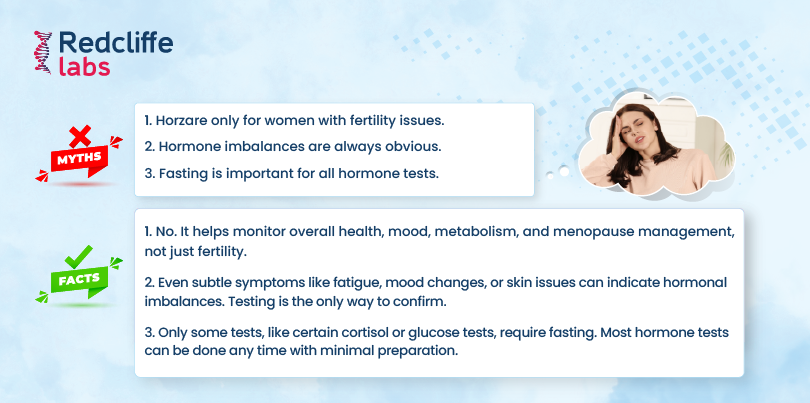
4. Do I need to fast before a hormone test?
For some hormone tests, such as some cortisol and glucose tests, you may need to fast beforehand. It is best to double-check with your doctor or lab about how you should prepare for a specific test. Following their instructions ensures the most accurate and reliable results.
5. How long does it take to get hormone test results?
The availability of female hormone test results depends on the hormones tested, and the lab chosen. Redcliffe Labs provides detailed reports within 1-3 days along with reference ranges. You can show your lab results to your doctor to identify imbalances and recommend any necessary treatments or lifestyle adjustments.
6. Can lifestyle affect my hormone test results?
Yes. Lifestyle factors such as stress, sleep patterns, medications, hormonal therapy, intense exercise, diet, and weight changes can affect your hormone test results. Always inform your doctor about your lifestyle and medications/supplements you are taking before testing to ensure accurate interpretation and avoid misleading results.
Additionally, lifestyle adjustments may also help improve hormone balance.
7. Why should I choose Redcliffe Labs for hormone testing?
You should choose us for offering accurate, reliable, and convenient female hormone testing with a range of women’s health packages. With professional phlebotomists, home sample collection options, and quick results, we ensure comfort and precision.
Further this helps women detect hormonal imbalances early and make informed decisions about their health and fertility.


