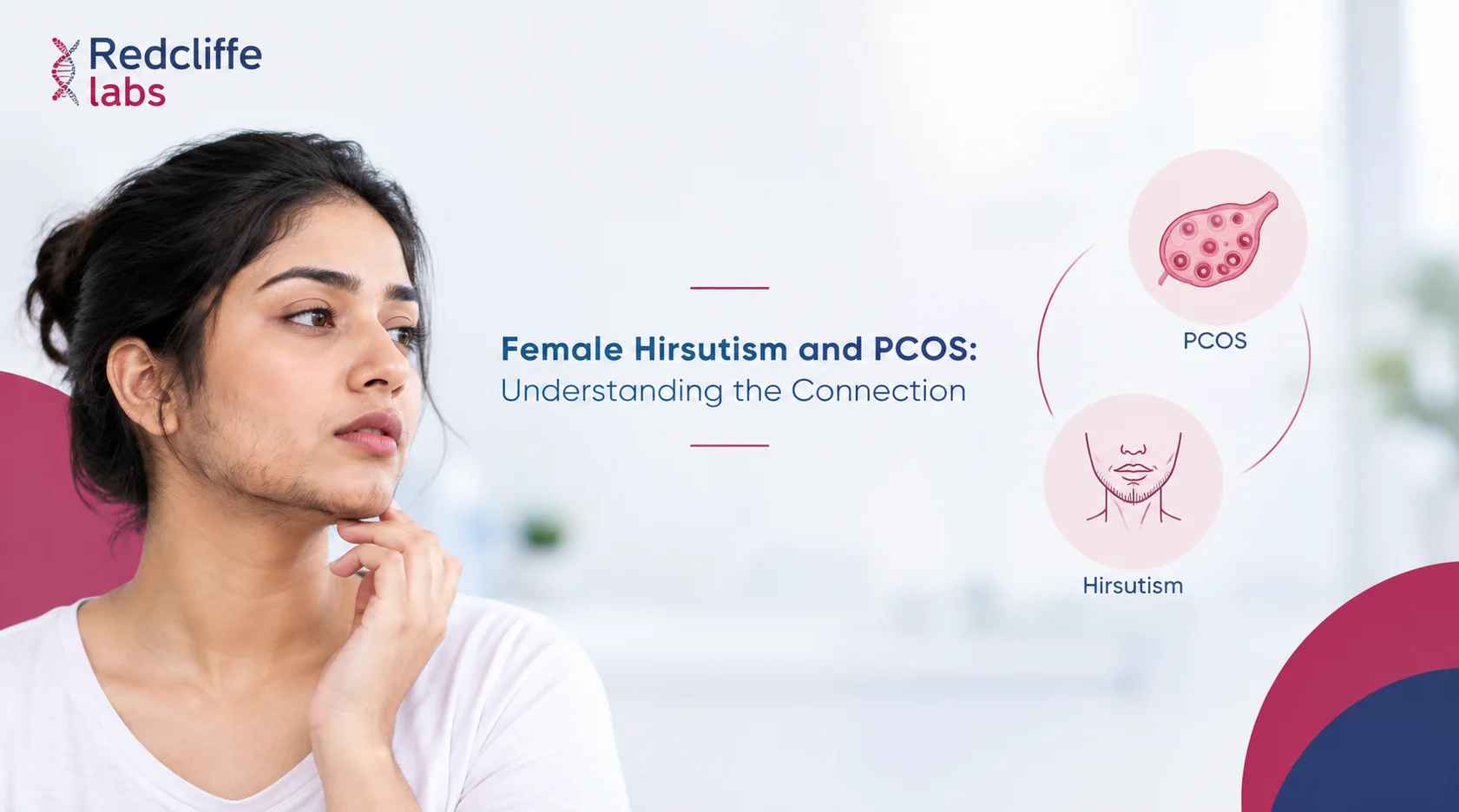
Female Hirsutism and PCOS: Understanding the Connection
Overview
- Hirsutism causes excessive growth of thick, dark terminal hair on areas such as the face, chest, abdomen, back, and thighs.
- PCOS is a common cause of hirsutism, but unwanted hair does not automatically mean PCOS. Genetics, medicines, and other conditions may contribute.
- Adult PCOS diagnosis considers ovulatory dysfunction, hyperandrogenism, and polycystic ovarian morphology or elevated AMH, after excluding other possible causes.
- Hirsutism can be managed with appropriate medical treatment, lifestyle measures for PCOS, and hair-removal methods such as shaving, laser, or electrolysis.
- Shaving does not make hair thicker, darker, or faster-growing. It may only feel rougher because shaving cuts hair bluntly.
- Not every woman needs a broad hormone panel. Testing depends on hair-growth pattern, menstrual history, symptoms, examination findings, and clinical suspicion.
- Rapidly worsening hirsutism or virilization signs such as voice deepening, increased muscle mass, or rapid scalp hair loss need medical evaluation.
Introduction
Finding a few unexpected, dark hairs on your chin, jawline, chest, or abdomen can be frustrating, especially when removing them becomes part of your regular routine. But unwanted facial or body hair is not a hygiene issue or personal failing. It can sometimes be linked to increased androgen activity or conditions such as Polycystic Ovary Syndrome (PCOS).
PCOS is a common cause of hirsutism, but having hirsutism does not automatically mean you have PCOS. Other hormonal conditions, medicines, genetics, and idiopathic hirsutism can also cause excess hair. In this blog, learn about the PCOS–hirsutism connection, possible causes, when testing may help, treatment options, and safe ways to manage unwanted hair.
What Is Hirsutism?
Female hirsutism refers to excessive growth of thick, dark terminal hair in a pattern that is more commonly seen in adult men.
It may affect areas such as:
- Upper lip
- Chin and jawline
- Chest
- Upper or lower abdomen
- Back
- Thighs
Everyone has body hair, but hair differs naturally in thickness, color, amount, and distribution. Genetic and ethnic differences can also influence normal hair growth.
Hirsutism specifically refers to the growth pattern and type of hair, rather than simply having more body hair than someone else.
Vellus Hair
Vellus hair is usually fine, short, soft, and light-colored. It covers much of the body and is often described as “peach fuzz.”
Terminal Hair
Terminal hair is thicker, longer, and usually darker. Hair on the scalp, eyebrows, underarms, and pubic region is generally terminal hair.
In hirsutism, increased androgen activity can cause thicker terminal hair to develop in androgen-sensitive areas such as the face, chest, abdomen, or back.
Also Read: How Stress Affects Your Insulin Sensitivity
What Causes Hirsutism in Females With PCOS?
Androgens are hormones naturally produced by both women and men. In women, androgens are produced mainly by the ovaries and adrenal glands.However, PCOS-related hirsutism is not caused by one pathway alone. Hormonal, metabolic, genetic, and follicular factors can all influence hair growth.
In some women with PCOS, androgen levels or androgen activity may be higher than expected. Insulin resistance can also contribute to this hormonal environment.
When the body becomes less responsive to insulin, the pancreas may produce more insulin. Higher insulin levels can contribute to increased ovarian androgen production and can reduce the liver's production of sex hormone-binding globulin (SHBG).
SHBG binds to sex hormones in the blood. When SHBG levels are lower, a greater proportion of testosterone may remain biologically available to tissues.
This combination of androgen activity, lower SHBG, metabolic factors, and the sensitivity of individual hair follicles can contribute to unwanted coarse hair growth.
What Are Some Early Signs of PCOS?
PCOS does not have one single early symptom. Possible features include:
- Irregular or infrequent periods
- Missed periods
- Excess facial or body hair
- Persistent acne
- Scalp hair thinning
- Difficulty with ovulation or fertility
- Metabolic problems such as insulin resistance
However, these symptoms can also occur for other reasons. For example, acne or irregular periods during adolescence may overlap with normal puberty.
Symptoms such as tiredness after meals or sugar cravings can have many causes and should not be considered specific signs of “early-stage PCOS.”
There is also no medically recognized “first stage” of PCOS. Diagnosis depends on the appropriate clinical criteria rather than the number of symptoms a person has.
At What Age Can Hirsutism Start?
Hirsutism can become noticeable after puberty as androgen activity changes. However, there is no single age at which hirsutism starts.
In teenagers, distinguishing normal pubertal changes from an underlying hormonal condition can be challenging. Acne, irregular periods, and changes in body hair can all occur during normal puberty and may overlap with PCOS features.
The 2023 International PCOS Guideline states that adolescents require a different diagnostic approach. Both ovulatory dysfunction and hyperandrogenism are needed for a PCOS diagnosis, while ultrasound and AMH are not recommended for diagnosing PCOS in adolescents because of their limited specificity during this stage.
New, rapidly worsening hair growth or signs of virilisation should be medically evaluated rather than assumed to be a normal part of puberty.
Can You Have PCOS Without Hirsutism?
Yes. You can have PCOS without noticeable facial or body hair.
Hirsutism is only one possible clinical sign of androgen excess. Some women with PCOS may have irregular ovulation or biochemical hyperandrogenism without developing obvious excess terminal hair.
Similarly, some women may have acne or scalp hair thinning without hirsutism.
PCOS diagnosis is therefore not based on facial hair alone. In adults, clinicians consider the appropriate combination of ovulatory dysfunction, clinical or biochemical hyperandrogenism, and polycystic ovarian morphology or AMH after excluding other conditions that can cause similar symptoms.
Is Hirsutism Always Caused by PCOS?
No. PCOS is a common cause of hirsutism, but it is not the only possible cause.
Other causes can include:
- Idiopathic hirsutism: Hirsutism without an identifiable hormonal disorder.
- Nonclassic congenital adrenal hyperplasia: An inherited condition that can increase androgen production.
- Certain medicines: Some medicines can contribute to increased hair growth.
- Other hormonal conditions: Conditions affecting the ovaries or adrenal glands may increase androgen activity.
- Androgen-producing tumors: These are uncommon but can cause rapid androgen excess and virilisation.
Your doctor may consider your menstrual pattern, how quickly the hair developed, other symptoms, family history, medicines, physical examination, and selected laboratory tests when looking for the possible cause.
Can Combined Hormonal Contraceptives Help With PCOS-Related Facial Hair?
Combined hormonal contraceptives containing estrogen and progestin may help reduce androgen-related symptoms in some women with PCOS.
Estrogen can increase SHBG levels, which reduces the amount of biologically available testosterone. Combined hormonal contraceptives can also suppress ovarian androgen production.
These medicines do not remove existing hair. Instead, they may help slow the growth of new terminal hair over time.
They are not suitable for everyone. A doctor should consider your medical history, risk factors, pregnancy plans, other medicines, and treatment goals before recommending them.
Visible improvement can take several months because hair grows in cycles. Medical treatment generally needs time before changes in hair growth become noticeable.
Can Lifestyle Changes Help Manage PCOS-Related Facial Hair?
Lifestyle measures can support overall PCOS and metabolic health, but they should not be presented as a guaranteed way to stop facial hair growth.
A healthy lifestyle may include:
Balanced Eating Pattern
Choose a balanced eating pattern that includes vegetables, fruits, whole grains, pulses, nuts, seeds, and appropriate sources of protein and dietary fat.
The goal is overall nutritional and metabolic health rather than following a specific “anti-hirsutism” diet.
Regular Physical Activity
Regular aerobic activity, strength training, or a combination of both can support metabolic health and insulin sensitivity.
Healthy Weight Management
For women with PCOS who have overweight or obesity, lifestyle interventions may improve metabolic health and may help reduce androgen-related symptoms.
However, PCOS management should not focus only on weight. Lifestyle recommendations should be individualized according to overall health, preferences, nutritional needs, and treatment goals.
Stress and Sleep
Adequate sleep and stress-management practices can support overall health and quality of life.
However, stress reduction should not be described as a direct treatment for hirsutism.
What Foods Can Help Reduce Hirsutism?
No specific food has been proven to permanently remove unwanted facial or body hair.
Instead of focusing on individual “anti-androgen” foods, women with PCOS can focus on a balanced eating pattern that supports overall metabolic and nutritional health.
This can include:
- Vegetables
- Fruits
- Whole grains
- Pulses and legumes
- Nuts and seeds
- Lean protein sources
- Healthy sources of dietary fat
There is no strong evidence that one particular food, tea, spice, or supplement can permanently reverse PCOS-related hirsutism.
Also Read: PCOD Diet Chart: A Guide to a Healthier Lifestyle
Can Ayurveda or Natural Remedies Treat Hirsutism?
Some people explore Ayurvedic or other complementary approaches for PCOS symptoms. However, there is limited high-quality evidence that Ayurvedic herbs, herbal teas, or topical preparations can treat hirsutism or permanently reduce androgen-related facial hair.
“Natural” does not automatically mean safe or effective. Herbal products may interact with medicines or may have inconsistent quality and dosing.
If you want to use complementary therapies alongside medical treatment, discuss them with your doctor or another qualified healthcare professional.
Is It Better to Shave or Pluck PCOS Facial Hair?
The most suitable hair-removal method depends on your skin type, hair type, personal preference, and whether you develop irritation or ingrown hairs.
Shaving: A Safe and Simple Option
Shaving cuts the hair at the surface of the skin and does not change the hair follicle.
Shaving does not make hair grow back thicker, darker, or faster. However, because the hair is cut bluntly, new growth may feel rougher or appear more noticeable.
To reduce irritation:
- Use a clean, sharp razor.
- Avoid shaving over irritated or broken skin.
- Use a gentle shaving product if needed.
- Avoid repeatedly going over the same area.
Shaving provides temporary results, so it needs to be repeated as the hair grows.
Plucking, Tweezing, and Waxing: Use With Care
Plucking and waxing remove hair from the root, but they can cause temporary redness and irritation.
Repeated hair removal may also contribute to:
- Ingrown hairs
- Skin irritation
- Inflammation
- Post-inflammatory darkening in some people
If you frequently develop ingrown hairs or have sensitive skin, a dermatologist can help you choose a more suitable hair-removal method.
Hair Removal for Hirsutism: Laser vs Electrolysis vs Shaving
|
Hair-removal method |
How it works |
What to expect |
|
Shaving |
Cuts hair at the skin surface |
Temporary removal; does not affect the follicle |
|
Waxing/plucking |
Removes hair from the root |
Temporary removal; may cause irritation or ingrown hairs |
|
Laser hair removal |
Uses light absorbed by hair pigment to damage the follicle and reduce future growth |
Long-term hair reduction; multiple sessions and maintenance may be needed |
|
Electrolysis |
Uses an electrical current to damage individual hair follicles |
Can provide permanent removal of treated hair follicles; multiple sessions are usually needed |
How Is PCOS-Related Hirsutism Treated?
Treatment usually has two goals: slowing new hair growth and managing existing unwanted hair.
Depending on the cause, severity, symptoms, and treatment goals, options may include:
|
Treatment |
Main purpose |
|
Lifestyle management |
Supports overall PCOS and metabolic health |
|
Shaving |
Temporary hair removal |
|
Waxing or plucking |
Temporary hair removal |
|
Laser hair removal |
Long-term reduction in hair growth |
|
Electrolysis |
Permanent removal of treated hair follicles |
|
Eflornithine cream |
Slows facial hair growth |
|
Combined hormonal contraceptives |
May reduce androgen-related symptoms |
|
Anti-androgen medicines |
Reduce androgen effects under medical supervision |
The Endocrine Society recommends an individualized approach to hirsutism, considering the degree of hair growth, underlying cause, symptoms, preferences, and treatment goals. Direct hair-removal methods can be used alongside medical treatment when appropriate.
Medical treatment does not remove existing coarse hair immediately. Because hair grows in cycles, it can take several months before noticeable improvement occurs.
How to Stop Facial Hair Growth in Females Permanently?
There is an important difference between permanent hair removal and long-term hair reduction.
Electrolysis
Electrolysis uses an electrical current to damage individual hair follicles. It can provide permanent removal of treated hair follicles.
Because hair grows in different cycles, multiple sessions are usually required. The procedure should be performed by a properly trained professional to reduce the risk of burns, scarring, pigmentation changes, or infection.
Laser Hair Removal
Laser hair removal uses light absorbed by pigment in the hair to damage the follicle and reduce future hair growth.
It generally works best when there is sufficient contrast between the hair and skin, although people with different skin tones may be treated with suitable laser technology and an experienced professional.
For women with PCOS, facial hair may regrow because hormonal factors can continue stimulating new hair growth. Therefore, laser treatment is better described as long-term hair reduction rather than guaranteed permanent removal.
Multiple sessions are usually needed, and women with PCOS may need additional sessions or maintenance treatment to manage regrowth.
Can Hirsutism Be Reversed?
Hirsutism can often be managed and reduced, but it may not completely disappear in every person.
If excess hair is related to PCOS or another hormonal condition, treating the underlying cause may help reduce new hair growth over time. However, existing coarse hair may still require direct hair removal.
Depending on the cause and severity, treatment may include:
- Lifestyle measures
- Combined hormonal contraceptives
- Anti-androgen medicines
- Eflornithine for facial hair
- Shaving
- Laser hair reduction
- Electrolysis
- Other dermatologist-recommended treatments
It is important to have realistic expectations. Hair grows in cycles, so medical treatment may take several months before visible improvement becomes noticeable.
How Can a Dermatologist Help With Facial Hair?
A dermatologist can assess unwanted facial hair, examine the skin and hair-growth pattern, and recommend suitable treatment.
Hair Removal
A dermatologist can discuss shaving, laser hair reduction, electrolysis, and other options according to your skin type, hair type, and risk of irritation or ingrown hairs.
Prescription Treatment
Prescription treatments may help slow facial hair growth or address an underlying hormonal condition when appropriate.
Skin Problems
A dermatologist can also manage problems associated with hair removal, including ingrown hairs, irritation, acne, and pigmentation.
If facial hair suddenly increases or becomes rapidly worse, medical evaluation is particularly important.
How Can Diagnostic Tests Help Find the Possible Cause?
Not every woman with unwanted facial or body hair needs a complete hormone panel.
There is no single standard hirsutism panel that every woman needs.
Your doctor may recommend specific tests based on the pattern and severity of hair growth, how quickly it developed, your menstrual cycle, acne, scalp hair loss, other symptoms, medicines, family history, and physical examination.
The Endocrine Society recommends androgen testing when the clinical assessment indicates a higher likelihood of an underlying androgen disorder. It also advises against routine androgen testing in women with regular menstrual cycles who have only unwanted local hair growth and no abnormal hirsutism score.
Depending on the clinical situation, a doctor may consider tests such as:
Testosterone
Total and free testosterone can help assess biochemical hyperandrogenism when clinically indicated. Free testosterone is particularly useful when total testosterone does not explain the clinical picture.
DHEA-S
DHEA-S is produced mainly by the adrenal glands. It may be considered when an adrenal source of androgen excess is suspected, particularly when hair growth is rapidly progressive or accompanied by other concerning features.
17-Hydroxyprogesterone
17-hydroxyprogesterone may be recommended when nonclassic congenital adrenal hyperplasia is suspected. It is not automatically required for every woman with hirsutism.
Other tests may be considered depending on symptoms and clinical findings. LH, FSH, SHBG, glucose, insulin, thyroid tests, prolactin, or other investigations are not universally required simply because a woman has hirsutism.
Importantly, hormone results should always be interpreted using the laboratory's reference range together with symptoms, menstrual history, examination findings, and other relevant clinical information.
What Does the Redcliffe Hirsutism Panel - Essential Include?
If your doctor recommends hormonal testing, the specific tests should be selected according to your clinical situation.
The current Redcliffe Labs Hirsutism listing- includes three parameters: DHEA-S, total testosterone, and free testosterone. It does not mean that these three tests are required for every woman with hirsutism, nor does it replace a clinician's assessment.
If your doctor has advised these tests, you can consider the Redcliffe Labs Hirsutism Panel - Essential or discuss which individual tests are appropriate for your symptoms.
Hirsutism vs. Hypertrichosis: Are They the Same?
No. Hirsutism and hypertrichosis describe different patterns of excess hair growth.
Hirsutism refers specifically to excessive terminal hair growth in a male-pattern distribution in women. It is often associated with androgen activity.
Hypertrichosis refers to excessive hair growth that can occur anywhere on the body and is not necessarily related to androgen excess.
This distinction matters because not every case of unwanted body hair is caused by PCOS or another hormonal condition.
Key Takeaways
Female hirsutism means excessive growth of coarse, dark terminal hair in areas where women typically have less hair. PCOS is a common cause, but hirsutism does not automatically mean you have PCOS. Other hormonal conditions, medicines, genetics, and idiopathic hirsutism can also cause excess hair.
In adults, PCOS diagnosis considers ovulatory dysfunction, clinical or biochemical hyperandrogenism, and polycystic ovarian morphology or AMH, after excluding other causes. Adolescents require a different approach because normal puberty can overlap with PCOS features.
There is no single standard hirsutism panel for every woman. Testing should be guided by clinical findings and interpreted with laboratory reference ranges, symptoms, and examination findings.
Lifestyle measures support overall PCOS health, while shaving, laser, and electrolysis can help manage unwanted hair. Sudden or rapidly worsening hair growth needs medical evaluation.
Frequently Asked Questions
Does having facial hair mean I have PCOS?
No. PCOS is a common cause of hirsutism, but facial hair can also result from genetics, idiopathic hirsutism, medicines, adrenal conditions, or other causes. A PCOS diagnosis requires assessment of menstrual/ovulatory function, androgen-related features, and other diagnostic criteria rather than facial hair alone.
Can you have PCOS with regular periods and no facial hair?
Yes. PCOS can present differently from one person to another. Some women may have biochemical hyperandrogenism or polycystic ovarian morphology without noticeable hirsutism. In adults, diagnosis is based on the appropriate combination of diagnostic features after other causes have been excluded.
Should every woman with facial hair get a hormone test?
No. Not every woman needs a broad hormone panel. Testing should be based on the amount and pattern of hair growth, menstrual history, other symptoms, physical examination, and clinical suspicion. Women with only localized unwanted hair and otherwise regular cycles may not require androgen testing.
Does shaving increase facial hair growth?
No. Shaving does not change the hair follicle or make hair grow thicker, darker, or faster. Because shaving cuts the hair bluntly, new growth may temporarily feel rougher or appear more noticeable.
How long does PCOS-related hirsutism treatment take to work?
Treatment usually takes time because hair grows in cycles. It can take several months before medical treatment produces noticeable changes in hair growth. Direct hair-removal methods can provide faster cosmetic results, while hormonal treatment helps reduce new hair growth over time.
How can you tell if facial hair is caused by PCOS?
PCOS-related facial hair is more likely when coarse, dark hair growth occurs with irregular periods, acne, scalp hair thinning, weight changes, or other signs of androgen excess. However, facial hair alone cannot confirm PCOS. A healthcare professional may recommend an examination and targeted testing.