Dengue NS1 Test: Early Detection, Accuracy, & Home Testing Explained

Medically Reviewed By
Dr. Mayanka Lodha Seth
Written By Sheena Mehta
on Sep 2, 2025
Last Edit Made By Sheena Mehta
on Sep 2, 2025
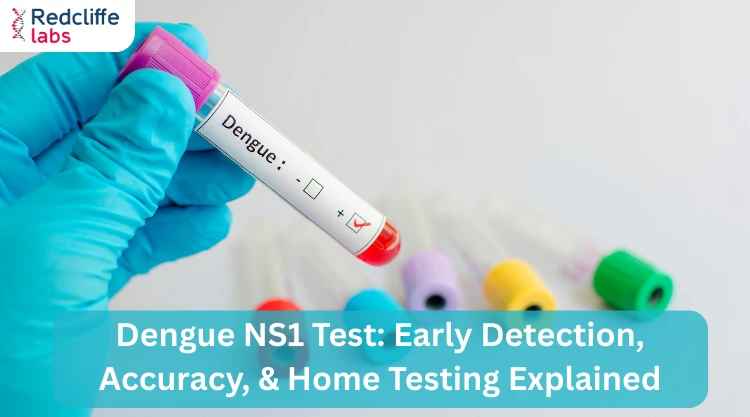
Every second counts; early diagnosis saves lives.
The Dengue NS1 Antigen Test enables doctors to detect dengue infections early, even before the body begins producing antibodies. It utilizes ELISA (Enzyme-Linked Immunosorbent Assay), an effective method for detecting dengue fever early on, particularly in its initial stages.
What Is NS1 and Why Does It Matter?
NS1 (non-structural protein 1) is a protein that the dengue virus puts into your blood. It serves as an early sign of infection, appearing even before your body begins producing antibodies to combat the virus.
NS1 can be detected through the ELISA test from the first day of fever and usually remains present for the first 7 days of illness. Dengue symptoms typically appear within 3-14 days of being bitten by an infected mosquito.
A positive antigen test for NS1 pinpoints acute dengue fever, indicating that the virus is present in the bloodstream, allowing doctors to initiate treatment.
It matters because:
- Confirms dengue early: The NS1 antigen test by ELISA is a widely preferred dengue test, known for its accuracy and ability to detect dengue early. NS1 appears in the blood before antibodies are formed, allowing diagnosis in the very first week of fever.
- Start timely treatment: The ELISA-based NS1 test ensures proper monitoring and care, which can reduce the risk of complications such as hemorrhagic fever or shock.
- Support outbreak control: The test identifies dengue cases early, which helps prevent community spread.
- No special preparation needed: The test involves a simple blood draw from a vein in the arm, making it convenient for them. No fasting is required.
- Cost-Effective and Widely Available: The test is cost-effective and accessible compared to other molecular tests, such as RT-PCR.
- Ordered with Additional Tests: It is sometimes paired with dengue IgM/IgG antibody tests for improved diagnostic accuracy.
- Specificity: The NS1 ELISA exhibits high specificity and sensitivity for dengue infection compared to many rapid card tests, thereby reducing the likelihood of false negatives/positives.
How does the test work?
Here is a breakdown of the test:
Principle
ELISA, which stands for Enzyme-Linked Immunosorbent Assay, uses synthetically labelled antibodies to find the dengue NS1 antigen in your blood, serum, or plasma. This binding produces a measurable signal confirming the presence of the protein.
Timing
Healthcare providers can typically detect the NS1 antigen from the first day of fever, and it remains detectable for about 7-9 days, sometimes longer. After that, antibody tests (IgM/IgG) are crucial.
Testing Procedure
The dengue test is a simple, non-invasive procedure that usually takes 5-10 minutes. The NS1 ELISA uses a blood sample, which is sent to a laboratory for analysis.
Sample Collection
- A small blood sample is drawn from a vein in the arm by a trained phlebotomist.
- No fasting or special preparation is required.
Laboratory Processing
- The blood sample is transferred to an ELISA plate pre-coated with anti-NS1 antibodies.
- If NS1 is in the blood, it binds to these antibodies.
Substrate Addition
- A second antibody, linked to an enzyme, is added to form a "sandwich." This is known as an Enzyme-Linked Immunosorbent Assay (ELISA) sandwich.
- A color-producing substrate is then introduced, which reacts with the enzyme to produce a color change.
Result Measurement
- Experts use an ELISA reader to measure the intensity of the color.
- An intense color indicates a positive result, indicating the presence of the NS1 antigen, while a no or minimal color change indicates a negative result.
Note: Like any routine blood test, you may experience mild pain or discomfort at the needle insertion site. It may cause dizziness or lightheadedness in individuals who are sensitive to it. A sporadic risk of infection at the puncture site if proper hygiene is not maintained.
What do the Dengue Test Results Indicate?
The dengue NS1 antigen test by ELISA results are usually reported as positive or negative.
-
Positive NS1 Antigen Result
It indicates the presence of acute dengue infection in your blood within the first 7 days of symptoms. Your doctor may recommend monitoring, appropriate treatment, and additional tests to track the stage of the disease.
-
Negative NS1 Antigen Result
No NS1 antigen detected in the blood. Testing too early or too late may mean the dengue is still present despite a negative result. Hence, repeat testing may be recommended, or an antibody (IgM/IgG) or RT-PCR test may be performed for confirmation.
Note: Contact a qualified professional for an accurate and professional interpretation of your test results.
Limitations of the Dengue NS1 Test
The test is helpful, but it has some limitations that you should be aware of:
- Time-sensitive accuracy: The test provides more accurate results within the onset of symptoms. After that, dengue antigen levels may drop, resulting in false negatives.
- No serotyping capability: The test cannot determine the serotype, which means it will not indicate which dengue virus you have: DENV-1, DENV-2, DENV-3, or DENV-4.
- Need for further testing: A negative test result doesn't confirm the presence of dengue. Persistent symptoms may require additional testing, such as IgM/IgG or RT-PCR, which may still be needed.
- The dengue NS1 test can detect dengue early, but it cannot predict the severity of the infection.
- Availability and access: In some areas, test availability may be limited, and the dengue NS1 test price can vary depending on the laboratory.
Book Dengue Test At Home from Redcliffe Labs!
Why step out when care can come to you? You can book the ELISA NS1 Dengue test at home from Redcliffe Labs. A well-trained phlebotomist will visit you at a preferred time with a blood collection kit, collect your blood sample under sterile conditions, and get accurate reports online within 18 hours.
Why Choose Us?
We are a good choice for home sample collection because:
- No travel, no waiting in queues: Get tested in the safe and comfortable environment of your own home, minimizing exposure, especially when experiencing fever or weakness.
- Expert staff: Our trained phlebotomists provide professional services and ensure a hygienic experience.
- Early and accurate diagnosis: We utilize advanced ELISA technology to deliver rapid NS1 results. This helps you and your provider act quickly and initiate treatment.
- Affordable & transparent pricing: The NS1 test is reasonably priced at INR 529, with no hidden charges included. Affordable testing ensures early detection of dengue, allowing for timely care.
- Trusted by 7 million patients: Redcliffe Labs is recognized nationwide for its commitment to reliability, precision, speed, and customer satisfaction.
Takeaway
The Dengue NS1 Antigen test by ELISA is an effective method to detect dengue early. It can differentiate from other febrile illnesses, supports public health tracking, and improves patient outcomes by facilitating prompt care.
FAQs
1. What is the ELISA test for dengue NS1 antigen?
The dengue NS1 antigen test by ELISA detects the NS1 protein of the dengue virus in the early stage of infection (day 1-7).
2. What is Elisa's test positive for dengue?
The positive result indicates the presence of the NS1 antigen, confirming acute dengue infection.
3. What is the cost of the ELISA test for dengue NS1?
The cost of the ELISA test for dengue NS1 is INR 529 at Redcliffe Labs, with home sample collection available.
4. What is the normal value of dengue NS1 antigen ELISA?
A negative or non-reactive result is the normal value of dengue NS1 antigen ELISA. A positive result indicates that the infection has been found.
5. How to Read the Dengue ELISA Report?
A positive NS1 test means you probably have a dengue virus infection, but it doesn't tell you which type. If your NS1 test is negative, it doesn't rule out the absence of illness. If you receive a negative NS1 test result, consider requesting a dengue IgM antibody test to check for a recent infection.
5. Can I test for dengue at home?
Yes. Call 898 898 87 87 or download the Redcliffe Labs mobile app to book a dengue test at home. We assure you of family-like care, accurate diagnostics, and compassionate support.
6. Who should take the test?
Individuals with dengue-associated symptoms, residing in dengue-endemic areas, or travelers who have recently returned from regions with dengue prevalence should undergo testing.