Ghee Calories Explained: How Much Is Too Much and Is It Healthy?

Medically Reviewed By
Dr. Geetanjali Gupta
Written By Sheena Mehta
on Feb 2, 2026
Last Edit Made By Sheena Mehta
on Feb 10, 2026

Before olive oil became cool and butter became mainstream, ghee was already ruling the kitchen.
From hot rotis dripping in ghee to that irresistible aroma in dal tadka, ghee has always known how to steal the spotlight. But with all eyes on calories today, this desi favorite is facing some serious questions.
So, does ghee really deserve the bad reputation? This blog takes a closer look at ghee's calories, its impact on weight, and whether it fits into a healthy diet.
What is Ghee & How Is It Made?
Ghee is clarified butter, prepared by heating butter to remove water and milk solids, leaving pure fat. As a result, ghee is more concentrated in fat compared to regular butter.
Did you know?
- You can make ghee at home using grass-fed butter. This butter is sourced from cows that eat green grass.
- Ghee has been used in Indian and Pakistani cultures and in Ayurvedic medicine since ancient times.
- The term' ghee'comes from ghṛta, meaning 'sprinkled' or 'poured.'
- It was created to prevent butter from spoiling during warm weather.
- It remains stable at room temperature.
How Many Calories Are in Ghee?
Ghee is almost pure fat, which makes it calorie-dense.
Calories in Ghee (approx.)
- 1 teaspoon (5 g) ghee: 45 calories
- 1 tablespoon (15 g) ghee: 120-135 calories
- 100 grams of ghee: 890-900 calories
How Does it Compare with Butter?
Although ghee and butter have similar nutritional properties, there are a few differences. Ghee is cooked longer, allowing the milk solids to turn golden brown. This gives ghee its rich, nutty flavor and aroma.
1 Tbsp Ghee Calories Vs 1 Tbsp Butter Calories
| Nutrient | Ghee | Butter |
| Calories | 123 | 100 |
| Fat | 14 grams | 11 grams |
| Saturated Fat | 9 grams | 7 grams |
| Monounsaturated Fat | 4 grams | 3 grams |
| Protein | 0 grams (trace amounts) | 0 grams (trace amounts) |
| Carbs | 0 grams (trace amounts) | 0 grams (trace amounts) |
| Vitamin A | 13% of Daily Value (DV) | 11% of the DV |
| Vitamin E | 3% of the DV | 2% of the DV |
| Vitamin K | 1% of the DV | 1% of the DV |
Note: Values may differ depending on brand and preparation method.
Ghee does not contain milk sugar, lactose,e and milk protein casein, whereas these are present in butter in small amounts.
However, you should avoid ghee and butter if you have a confirmed casein allergy. Additionally, if you are lactose intolerant, you can consume ghee as it contains very small amounts of lactose and casein.
Are Ghee Calories Bad for Health?
No, ghee calories are not necessarily bad. However, because ghee is calorie-dense and high in fat, excessive consumption can lead to weight gain. Excessive intake may contribute to higher LDL (bad) cholesterol in some individuals.
Recommended Intake: Most nutrition experts suggest 1 to 2 teaspoons of ghee per day for healthy adults, depending on activity level.
Also read: https://redcliffelabs.com/myhealth/web-stories/top-7-health-benefits-of-eating-ghee-daily/
Culinary Uses
Key culinary uses of ghee include:
- Cooking & Sautéing: Ghee is ideal for frying, roasting, and tempering dal due to its high smoke point.
- Indian breads: Brushed onto rotis, parathas, naans, and puris.
- Dal and curries: Used for tempering (tadka) dal, gravies, and vegetable curries.
- Rice dishes: Added to plain rice, khichdi, and biryani for richness.
- Sweets and desserts: Essential in halwa, laddoos, barfi, and other traditional sweets.
- Baking and cooking alternative: Can replace butter or oil in baking and everyday cooking.
Is Ghee Good for Weight Loss or Weight Gain?
Ghee can contribute to both weight loss and weight gain, depending on how much you consume. Since ghee contains calories, excessive consumption can easily push your calorie intake above your daily requirements, resulting in weight gain.
However, eating ghee in moderation supports weight management. Since ghee contains healthy fats, it can help you feel full for longer, reducing frequent snacking and overeating. Thus, you can maintain a calorie deficit, which is essential for weight loss.
Who Should Be More Careful with Ghee Intake?
People who should limit or monitor ghee intake:
- Those with high LDL (bad) cholesterol
- A family history of heart disease
- People with low physical activity levels
- Individuals suffering from fatty liver disease, jaundice, gallbladder stones, or gallbladder disease
- Those aiming for weight loss
- Individuals with digestive problems such as discomfort, bloating, or diarrhea.
- Individuals with a cold and cough (traditional belief)
- Those with severe milk protein allergies
Tips for Safe Consumption:
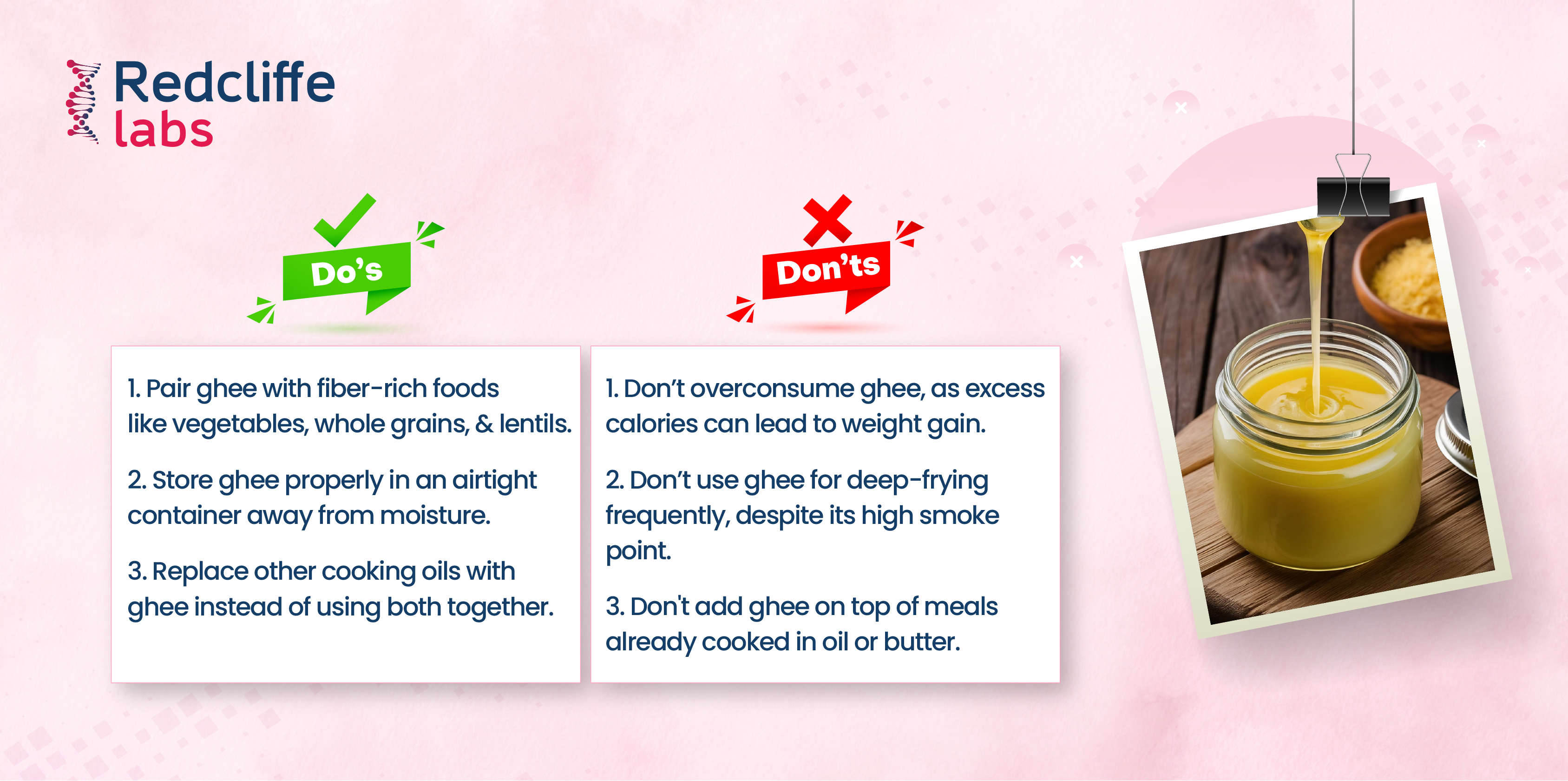
- Moderation is key: Limit your ghee intake to 1-2 teaspoons per day.
- Swap, don't add: Use ghee instead of other cooking oil. Avoid adding it on top of already cooked dishes in oil.
- Pair with fiber: Include vegetables, whole grains, or lentils in your meals to balance the calorie-dense ghee and aid digestion.
- Consult a professional: Always consult a dietitian or a cardiologist before adding ghee to your diet.
6 Best Ways to Add Ghee to a Healthy Diet
Here is how you can include ghee in your diet:
- Use small portions: Stick to ½-1 tsp per meal to relish the taste without calorie overload.
- Cook with ghee instead of oil: Replace refined oils with ghee rather than using both together.
- Add ghee to warm foods: Put it on dal, rice, or vegetables so it melts evenly, and you use less.
- Pair with fiber-rich foods: Combine ghee with whole grains, lentils, and vegetables to slow digestion and improve satiety.
- Avoid deep-frying: Use ghee mainly for light sautéing, tempering, or finishing dishes.
- Balance your day's fat intake: If you use ghee in one meal, limit other fats in the rest of the day.
FAQs
1. Is ghee high in calories?
Yes, ghee is high in calories since it is mostly pure fat. A tablespoon of ghee has approximately 120-135 calories. It is a calorie-dense food, so even small amounts can greatly contribute to your daily calorie intake. That is why it is crucial to control the portions of ghee when having it regularly.
2. Can eating ghee daily cause weight gain?
Eating ghee every day does not necessarily lead to weight gain. Weight gain happens when you eat more calories than your body requires. Taking 1-2 teaspoons of ghee each day can be a part of a healthy diet, especially if you eat lots of fiber and exercise regularly.
3. Is ghee better than butter for calorie control?
Ghee has slightly more calories than butter, but it is free of lactose and casein and has a higher smoke point. This means it is more heat-resistant.
If used in small quantities, ghee may be gentler on the stomach and can substitute butter without making a big difference in calorie intake.
4. Can ghee help with weight loss?
Ghee can support weight management when consumed in moderation. The fat in it helps increase the feeling of fullness, which may reduce cravings for snacks and overeating. However, ghee by itself is not a weight-loss agent. It should be included in controlled portions as part of a calorie-balanced diet and healthy lifestyle.
5. How much ghee is safe to eat every day?
Generally, experts recommend limiting ghee intake to 1-2 teaspoons per day for healthy adults. This quantity is enough to let you savor the flavor and benefits without eating too many calories. Individual needs may vary depending on age, activity level, and overall dietary fat intake.
6. Can people with lactose intolerance eat ghee?
Ghee is a good choice for people with lactose intolerance because it contains only traces of lactose and casein. Nevertheless, people who have an actual casein allergy should avoid ghee. If you have any digestive issues, it is advisable to start with a very small amount.
7. Does ghee increase cholesterol levels?
Excessive consumption of ghee may raise the LDL (bad) cholesterol level because ghee contains a high amount of saturated fat.
However, moderate intake within daily calorie limits is not expected to be harmful to healthy people.
Those with high cholesterol or heart disease should limit their ghee consumption and consult their doctor.
The Bottom Line
Even though ghee contains a lot of calories, it doesn't make it unhealthy. When used in limited amounts, ghee can be a nutritious addition to your diet, supporting digestion, immunity, and overall well-being. The key lies in portion control and balance.
Ghee is a natural edible food that has been used extensively in cooking and traditional practices. Ghee has some favourable properties compared to butter. For example, it has a higher smoke point and is better tolerated by people with lactose intolerance, but one should not consider it a health superfood.
Ghee and butter can both be enjoyed in moderation as part of a balanced diet. However, there is no strong evidence to suggest that ghee is significantly healthier than butter.
Most of the touted health benefits of ghee are exaggerated because the beneficial components are present only in very small amounts. The key is mindful consumption and portion control.