1 Roti Calories: How Many Calories in One Roti? (Nutrition Facts 2026)


Table of Contents
- What is Roti?
- How Many Calories in 1 Roti?
- Calories by Roti Type (All Variants)
- Roti Nutrition Facts Per 100g
- Health Benefits of Eating Roti
- How Many Rotis Should You Eat Per Day?
- Roti vs Rice: Which Has Fewer Calories?
- Conclusion
- Frequently Asked Questions
What is Roti?
Roti (also called chapati or Indian flatbread) is a staple unleavened bread made from whole wheat flour (atta), water, and sometimes a small amount of oil or ghee. The dough is rolled into thin circles and cooked on a hot griddle (tawa) until light brown spots appear on both sides. It is the most consumed carbohydrate source across Indian, Pakistani, and Bangladeshi households, typically served with dal, sabzi, curd, or curry.
Made from whole wheat, roti provides complex carbohydrates, dietary fibre, plant protein, B vitamins, and key minerals, making it nutritionally superior to refined flour alternatives like maida roti or white bread.
How Many Calories in 1 Roti?
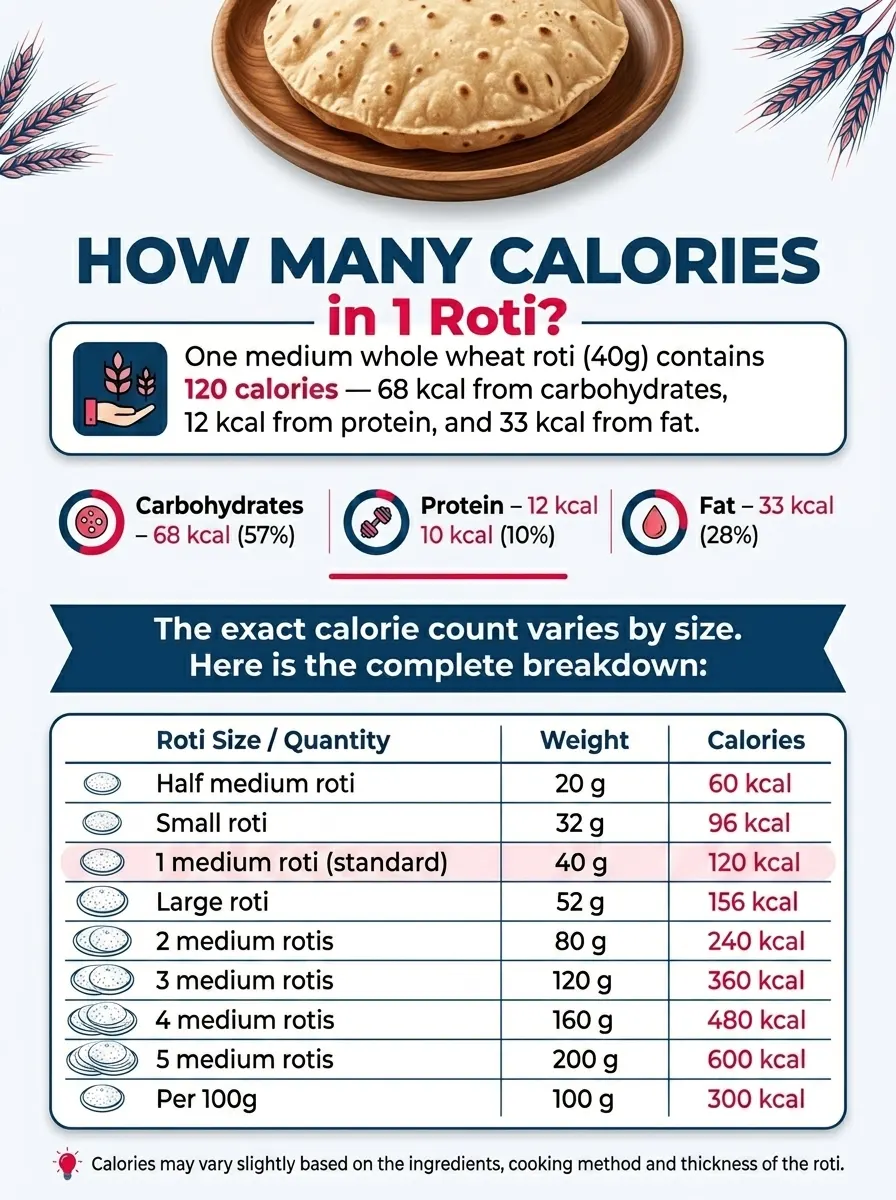
One medium whole wheat roti (40g) contains 120 calories - 68 kcal from carbohydrates, 12 kcal from protein, and 33 kcal from fat.
The exact calorie count varies by size. Here is the complete breakdown:
| Roti Size / Quantity | Weight | Calories |
|---|---|---|
| Half medium roti | 20 g | 60 kcal |
| Small roti | 32 g | 96 kcal |
| 1 medium roti (standard) | 40 g | 120 kcal |
| Large roti | 52 g | 156 kcal |
| 2 medium rotis | 80 g | 240 kcal |
| 3 medium rotis | 120 g | 360 kcal |
| 4 medium rotis | 160 g | 480 kcal |
| 5 medium rotis | 200 g | 600 kcal |
| Per 100g | 100 g | 300 kcal |
Quick answer: 1 roti = 120 calories (for a standard 40g medium-sized chapati made from whole wheat flour without added ghee).
Calories by Roti Type (All Variants)
One of the most searched questions is how calories differ across roti types — wheat, multigrain, millet, and ghee rotis. Here is a complete comparison per 1 roti (40g serving):
| Roti Type | Calories (per 40g roti) | Calories per 100g | Key Benefit |
|---|---|---|---|
| Whole wheat roti | 120 kcal | 300 kcal | High fibre, low GI |
| Multigrain roti | 110 kcal | 275 kcal | Most nutrient-dense |
| Bajra (pearl millet) roti | 118 kcal | 295 kcal | High iron and magnesium |
| Jowar (sorghum) roti | 112 kcal | 280 kcal | Gluten-free, diabetic-friendly |
| Ragi (finger millet) roti | 114 kcal | 285 kcal | Highest calcium of all rotis |
| Makki (corn) roti | 116 kcal | 290 kcal | Rich in Vitamin A |
| Besan (chickpea flour) roti | 130 kcal | 325 kcal | Highest protein content |
| Oats roti | 105 kcal | 262 kcal | Best for weight loss |
| Roti with 1 tsp ghee | 160 kcal | — | Adds 40 kcal per tsp ghee |
| Maida (refined flour) roti | 135 kcal | 337 kcal | Avoid — high GI, low fibre |
Note: Values are approximate and vary based on rolling thickness and exact flour blend used.
Roti Nutrition Facts Per 100g
Beyond calories, here is the complete macronutrient, vitamin, and mineral profile of a standard whole wheat roti per 100 grams:
Macronutrients
| Nutrient | Amount per 100g |
|---|---|
| Calories | 300 kcal |
| Carbohydrates | 46.13 g |
| Dietary Fibre | 10.7 g |
| Protein | 7.85 g |
| Total Fat | 9.2 g |
| Saturated Fat | 1.3 g |
Vitamins
| Vitamin | Amount per 100g |
|---|---|
| Vitamin B1 (Thiamine) | 0.36 mg |
| Vitamin B2 (Riboflavin) | 0.18 mg |
| Vitamin B3 (Niacin) | 4.61 mg |
| Vitamin B6 | 0.28 mg |
| Vitamin B9 (Folate) | 0.038 mcg |
| Vitamin E | 0.55 mg |
| Vitamin K | 0.003 mg |
Minerals
| Mineral | Amount per 100g |
|---|---|
| Potassium | 196 mg |
| Magnesium | 56 mg |
| Calcium | 36 mg |
| Sodium | 298 mg |
| Iron | 2.2 mg |
| Phosphorus | 150 mg |
Source: USDA FoodData Central; Indian Food Composition Tables (NIN, ICMR)
Health Benefits of Eating Roti
The soft rolled chapati is a staple food in India relished with sabzi, dal, chutney, and pickle (achar). Made from wheat rotis have numerous advantages added to its bag of health benefits. Some of them are listed as follows:
- Roti is an ideal alternative to other calorie-rich, carbohydrate-fortified diets. And people looking to lose weight or considering a low-calorie diet can opt for rotis.
- Rotis are low in the glycemic index (GI). This low GI food does not shoot up the sugar levels, making it the most preferred food of people with diabetes and other metabolic disorders like heart disorders.
- Rotis have vitamin B1, an antioxidant that helps neutralise the free radicals that damage the body.
- Without oil chapatis or rotis gives you an option of a low-fat roti that can help you cut down the calories furthermore.
- Rotis have high dietary fibre compared to other carbohydrate-rich foods — helps ease bowel movements and digestion issues.
- Chapatis with dal, vegetables, paneer, and soya, help enhance protein, vitamin, mineral, and fibre content in the diet.
- Rotis with whole wheat flour plus the other low GI flours can improve the nutritional values while keeping low calories in homemade rotis.
- Roti helps maintain a healthy lifestyle while helping maintain a low-calorie diet.
How Many Rotis Should You Eat Per Day?
The right number of rotis per day depends on your calorie target, which varies by goal, gender, age, and activity level:
| Goal | Sedentary | Moderately Active | Very Active |
|---|---|---|---|
| Weight loss | 4–6 rotis/day | 6–8 rotis/day | 8–10 rotis/day |
| Weight maintenance | 6–8 rotis/day | 8–10 rotis/day | 10–12 rotis/day |
| Muscle gain | 8–10 rotis/day | 10–12 rotis/day | 12–14 rotis/day |
Important notes:
- These figures assume a standard 40g medium roti made without ghee.
- If using ghee, each teaspoon adds ~40 kcal — account for that in your daily total.
- Rotis should ideally account for no more than 50–60% of your total carbohydrate intake; pair with protein (dal, eggs, paneer) and vegetables.
- Children aged 6–12 typically need 2–4 rotis per meal; adolescents 2–5 per meal depending on activity.
Consult a registered dietitian for a personalised roti intake recommendation based on your specific health conditions, blood sugar levels, or weight loss goals.
Roti vs Rice: Which Has Fewer Calories?
A common question from people managing weight or blood sugar is whether roti or rice is the better choice. Here is a direct comparison:
| Parameter | 1 Medium Roti (40g) | 1 Cup Cooked Rice (150g) |
|---|---|---|
| Calories | 120 kcal | 195 kcal |
| Protein | 3.1 g | 4.0 g |
| Fibre | 4.3 g | 0.6 g |
| Fat | 3.7 g | 0.4 g |
| Glycaemic Index | ~62 (Low) | ~72 (Medium-High) |
| Sodium | 119 mg | 1 mg |
Verdict: Roti is lower in calories per serving, significantly higher in fibre, and has a lower GI — making it generally the better choice for weight management and blood sugar control. However, rice is lower in sodium and fat, making it preferable for people managing blood pressure or on low-fat diets. Both can be part of a healthy diet; portion control matters more than which you choose.
Conclusion
Rotis are a great low-calorie food to be included in the diet. Roti made with millets, Bengal grams, pulses flour plus whole wheat flour gives you a multi-grain flour that can further lower your calorie intake and enhance its nutritional value. Rotis, a staple food in India, is routinely made every day in every Indian kitchen. Switch to roti and ditch the other high-calorie, carbohydrate-rich foods if you want to lose the extra weight. With a lot of health benefits, rotis help you stay fit and lean.
Frequently Asked Questions
How many calories are in 1 roti?
One medium whole wheat roti weighing 40g contains 120 calories — 68 kcal from carbs, 12 kcal from protein, and 33 kcal from fat. A small roti (32g) has about 96 calories and a large roti (52g) has about 156 calories.
How many calories are in 1 roti with ghee?
Adding 1 teaspoon of ghee (approximately 5g) to a roti adds 40 calories, bringing the total to approximately 160 calories per roti with ghee. Two tsp ghee = 200 kcal per roti.
Is roti good for weight loss?
Yes, roti can support weight loss when consumed in controlled portions. At 120 kcal per roti with 3.1g protein and 4.3g fibre, it is filling and nutrient-dense. Choosing oats roti (105 kcal) or multigrain roti (110 kcal) reduces calories further. The key is pairing roti with vegetables and dal rather than heavy gravies.
How many rotis should I eat in a day to lose weight?
For weight loss, most adults on a 1,500–1,800 kcal diet can include 4–6 medium rotis per day, spread across meals. However, the exact number depends on your total calorie target, activity level, and what else you eat. Consult a dietitian for a personalised plan.
Which roti has the least calories?
Oats roti (approximately 105 kcal per 40g) has the fewest calories among common roti types, followed by multigrain roti (110 kcal). Both are also higher in soluble fibre than plain whole wheat roti, making them excellent choices for weight loss and diabetes management.
How many calories are in 2 rotis?
Two medium whole wheat rotis (80g total) contain approximately 240 calories — 136 kcal from carbs, 24 kcal from protein, and 66 kcal from fat.
Is bajra roti or wheat roti better for diabetes?
Both are suitable for people with diabetes due to their low glycaemic index. Bajra roti (GI ~55) has a slightly lower GI than whole wheat roti (GI ~62) and is higher in iron, magnesium, and fibre — making it a marginally better choice for blood sugar management. People on diabetes medication should monitor portions and consult their doctor.
How many calories are in a besan roti?
One besan (chickpea flour) roti of 40g contains approximately 130 calories, making it the highest-calorie roti type — but also the highest in protein (~5g per roti), making it an excellent choice for people seeking to increase protein intake.