Identify Rising Blood Sugar- 5 Signs That Appear In Feet Indicating Diabetes

Medically Reviewed By
Dr. Ragiinii Sharma
Written By Prekshi Garg
on Aug 31, 2022
Last Edit Made By Prekshi Garg
on Jan 23, 2025

Diabetes or increased sugar levels in your blood is a commonly occurring chronic disease that affects the way in which glucose is being processed and utilised in your body. Diabetes may happen due to insufficient production of insulin from the pancreas or due to ineffective utilisation of the produced insulin. Diabetes is a common health disease that occurs in India. In 2019, around 77 million people were diagnosed with diabetes in India alone.
In a world where every other person is suffering from diabetes, it is very important to know about the signs of rising blood sugar levels so that timely treatment can be taken.
In this article, let us talk about the major 5 signs that appear in feet and are an indication of rising blood sugar levels.
How can diabetes affect your feet?
Diabetes leads to the development of various symptoms in your feet as well. There are basically two ways by which diabetes can affect your feet. These include diabetic neuropathy and peripheral vascular disease.
Diabetic neuropathy
Your nerves can be damaged due to uncontrolled diabetes. In case of nerve damage in your feet and legs, you will not feel any pain or temperature fluctuations in your legs or feet. This condition is also known as sensory diabetic neuropathy. Neuropathy can make your foot prone to cuts and can also lead to soreness which can get infected or worsen due to prolonged exposure. When your nerves to the muscles get damaged, the muscles of your foot will not work properly. This can lead to misalignment of your foot causing exertion of pressure on one part of your foot specifically.
Peripheral vascular disease
Diabetes can affect the adequate flow of blood as well. Inadequate flow of blood hinders the healing of cuts and sores which can take a longer time to heal. Peripheral vascular disease refers to the poor or inadequate flow of blood to your arms and legs. Poor flow of blood takes prolonged time for healing of the wounds making you prone to the development of gangrene and ulcers.
What are the symptoms of rising blood sugar levels?
Diabetes is not specific to one organ, and thus you can observe the signs of diabetes in different parts of your body. Your feet is one such part, which can indicate rising blood sugar levels. There are various presentations that appear in your feet as a symptom of increased blood sugar levels. The top 5 symptoms of rising blood sugar levels observed in your feet are listed below.
Fungal infection of nails and ingrown toenails
Your nails might get infected with fungus that make your nails discoloured (that is opaque or yellowish-brown), brittle, and thick. Your nails might also start to crumble in certain cases. The growth of fungi is facilitated by the warm, moist, and dark environment that persists due to your shoes or gloves. Injury is another common cause for the development of fungal infection in your nails. Fungal infections are a challenge to treat. A few of the fungal infections can be treated through tropical medicines. Oral medicines can also be prescribed by your doctor. You can also get your damaged nail removed from a surgeon.
Ingrown toenail refers to a condition wherein the edges of your nail grow into your skin. The ingrowth of the nails causes pain and pressure on the edges of your nail. If the edges of the nail get cut into your skin, it can lead to pain, redness, swelling, infection, and drainage. Ingrown nails are usually caused due to the pressure exerted from your shoes, crowding of the toes, improperly trimmed nails, and repeated trauma (walking, running, aerobics) to the feet. The severe complication of ingrown toenails can be treated by the surgical removal of the part of the toenail and the growth plate as well.
Corns, blisters, and ulcers
Corn refers to the case where hard skin buildup occurs near the bony area present between toes. The general cause of development of corns is the pressure developed when your shoes rub against your toes or due to the friction between your toes. You can remove the build-up of hard tissue by the use of a pumice stone daily after bath. Avoid using over-the-counter medicines that work by dissolving your corns or removing them with the use of a sharp object.
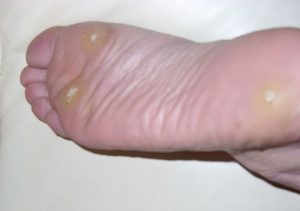
The constant rubbing of the same spot of your feet with the shoes can lead to formation of blisters. Avoid wearing improperly fitted shoes or wearing them without socks, as it can lead to blister formation. Blisters can get infected easily, therefore, use an antibacterial cream with soft bandages to protect your skin from infections.
Diabetic or foot ulcers refer to a deep sore or a break in the skin. These diabetic ulcers are also prone to infection. Minor scrapes, slow healing of cuts, and improperly fitted shoes are some of the common causes for formation of ulcers. Foot ulcers are commonly found in around 10% of the people with diabetes.
Calluses and plantar warts
The hard skin buildup on the underside of your foot is commonly referred to as a callus. Uneven distribution of weight, poor fitting of shoes, and skin problems are the major causes of development of calluses. The occurrence of callus on your foot can sometimes be normal as well. Use of pumice stone every day after bath can help in gentle removal of the build-up tissue. You can also use medicines, cushioned pads, and insoles in your shoes to soften calluses.
Plantar warts are also similar to calluses and very commonly occur on the ball of your foot or the heels. You may observe tiny black spots or small pin holes at the centre of the warts. These may grow singly or in clusters and are usually very painful. The main cause of plantar warts is viral infection of the outer layer of the soles of your feet.
Athlete’s foot
Athlete’s foot refers to fungal infection that leads to redness, itching, and cracking of the skin. Cracks present on your skin allow the entry of the germs leading to infection. Antifungal medicines in the form of pills or cream can effectively kill the fungus and are thus used for the treatment of athlete’s foot.
Bunions
When your big toe bends towards the second toe, it leads to the formation of bunions. Redness and callus formation can take place at the point where your big toe joins your foot. This part of your feet can stick out and become hard. The formation of bunions can take place in either one or both the feet. Wearing high heeled footwear with narrow toes is the major cause of bunion formation. However, sometimes, it can also occur due to genetic reasons. If your bunions irritate you a lot, you can use felt or foam padding for your comfort. In severe cases, a surgery is recommended for realignment of the toes.
Diabetes is a life-long disease and you need to monitor your sugar levels regularly to keep them under the recommended range. It is very important that you observe your symptoms also as they may indicate if your sugar levels are rising. The effect of diabetes can be seen on your whole body. Thus, there are various symptoms of diabetes presented by different parts of your body. If you observe any unusual change in your body you must check your sugar levels and consult your doctor as well.
What are the symptoms of diabetic foot problems?
The foot problems in diabetic people can be presented in the form of various signs and symptoms that include:
- Changes in the temperature and colour of your skin.
- Occurrence of swelling in your ankle and foot
- Development of open sores on the feet that takes a longer time to heal
- Pain in the legs
- Development of corns and calluses in your feet
- Formation of ingrown toenails
- Your toenails might get infected with fungus
- An unusual foot odour
- Formation of dry cracks in the skin especially around the heel area.
How can you take care of your diabetic foot?
People with diabetes must take utmost care of their feet to prevent these common foot problems and treat them at an early stage itself to prevent some serious complications. Here are some of the tips that can help you take good care of your feet.
- Monitor your blood sugar levels efficiently and try keeping them within the recommended range.
- Proper nutrition, regular exercise, and medicines are very important to follow religiously.
- Use a mild soap and warm water to wash your feet every day. You can check the temperature of the water with your elbow as the sensation in your hands can get affected by the nerve damage. Dry your feet nicely, especially between your toes.
- Observe your feet regularly for development of blisters, sores, redness, and calluses.
- Keep the skin of your feet hydrated by applying a moisturising lotion on the skin. Be careful that you don't apply too much lotion. Also avoid applying lotion between the toes of your feet.
- Use a pumice stone or an emery board to smooth out corns and calluses regularly after bath. You must use the emery board in one direction only.
- Always keep your toenails trimmed with a nail clipper. Always use a nail file to smoothen the toenails after clipping.
- Do not keep your toenails rounded or cut the sides of your nails.
- Avoid walking barefoot around your house. You can use close-toed slippers and shoes.
- Wear stockings or socks that have a soft elastic and fit your feet well.
- Wear well fitted shoes. Do not buy shoes that are too tight on your feet.
- Always ensure that there are no tiny particles or objects left inside your shoes.
- You must always protect your feet from hot and cold temperatures.
- Move or wiggle your toes at regular intervals while you are sitting to ensure that the blood flows continuously to your feet.
- Quit smoking as it can affect the flow of your blood.
- Contact your doctor if you have any wounds that won’t heal for a long time.
- You should go for a foot exam at least once a year.
Also Read:- Understanding Your HbA1C Results for Diabetes?
Can diabetic foot problems lead to complications?
Diabetic foot problems can lead to severe complications if they persist for a long time. Following are the most common complications of diabetic foot problems.
Abscess
Abscess refers to the formation of a pocket of pus formed when infections eat your body tissues or bones as well. Draining the abscess is the most common treatment available. Surgical removal of bone or tissue might be done along with drainage. However, less invasive techniques like oxygen therapy are also available for the treatment.
Skin and bone infection
Infections are very common to occur through a small cut or wound. Problems related to the immune system, blood vessel and nerve damage can make you more prone to infection.
Deformities
Your feet muscles can weaken due to nerve damage that can lead to deformities like claw feet, hammertoes, pes cavus, prominent metatarsal heads, and high arch.
Gangrene
Diabetes can also affect the supply of blood vessels to your toes and fingers. Blockage or cut off of the blood flow can lead to the death of the tissue.
Amputation
Diabetes leading to blood flow problems and nerve damage makes you more prone to foot injury and infection. Amputation is considered as the best treatment in cases when your infection doesn't heal, low blood flow, and abscess creation.

Takeaway
Diabetes is a commonly occurring metabolic disorder in India. The increasing blood sugar levels can be presented by our body in various forms. Many of the symptoms of increased blood sugar levels are observed in your feet. These symptoms are very important to get noticed at an early stage. Now that you know the common symptoms presented in your feet due to rise in blood sugar levels, make sure that you observe them well in time and take appropriate treatment to avoid future complications. It is very important for people with diabetes to take good care of their feet to prevent diabetic foot problems.
Frequently Asked Questions (FAQs)
1. What are the things that diabetic people should avoid doing to their feet?
Following are some things that people with diabetes should not do:
- Do not soak your feet in water as it can make your skin dry. You should only wash your feet with lukewarm water properly.
- Do not walk barefooted.
- Do not apply a lot of oil or cream between your toes as it can make your toes moist making room for infection.
2. Who is at a higher risk of diabetes-related foot conditions?
Diabetes related foot conditions can occur in any individual with high blood sugar levels, however, there are certain people who are at a higher risk of developing diabetes-related foot conditions.
- Nerve damage in the feet
- Poor blood flow
- Hyperglycemia
- Weight issues
- High cholesterol or blood pressure
- Prolonged diabetes
3. What are the common symptoms of diabetes?
Some of the common symptoms of diabetes or increasing blood sugar levels include:
- Frequent urination
- Increased thirst and hunger
- Fatigue
- Tingling sensation or numbness in feet and hands
- Blurred vision
- Slow-healing sores
- Frequent infection


