
Creatinine, Serum in Noida
The Creatinine Test measures the level of creatinine, a waste product produced by muscle metabolism, in your blood or u...Read more




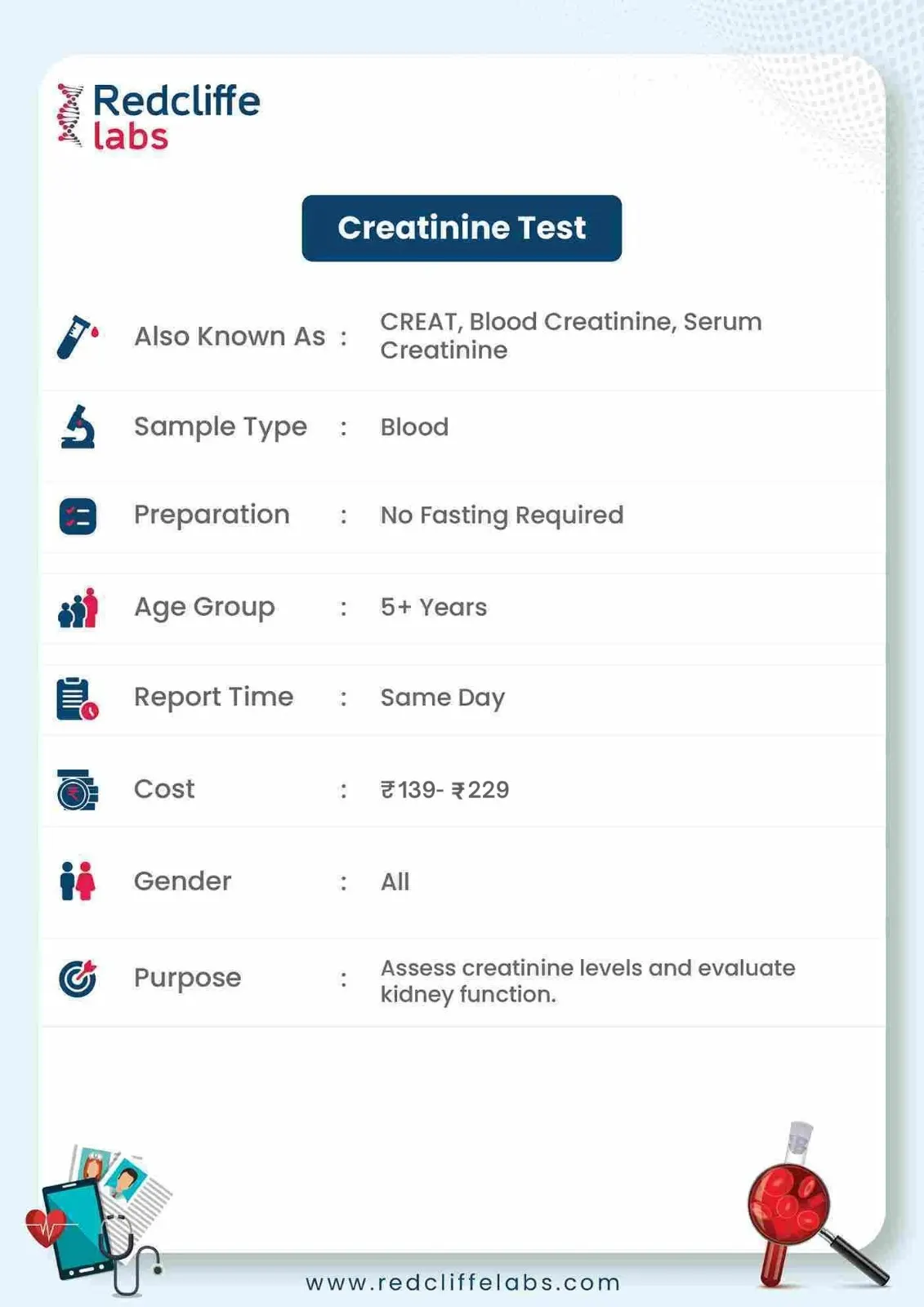
Blood


Unlock special
discount on
this package
Login to Unlock 🔓
1 Test Parameters

Creatinine
1 PARAMETER INCLUDED
1 PARAMETER INCLUDED
- Creatinine
Helps you know your test better
Who all are eligible for Urea Creatinine test?
- People who have various types of kidney infections.
- People with type 1 or type 2 diabetes and who are facing the following symptoms, including nausea, vomiting, muscle cramps, high blood pressure, chest pain, and fatigue like signs and symptoms.
Why take Serum Creatinine test?
- A doctor may recommend this test for the screening of kidney disease and if you have diabetes, high blood pressure, or any other condition that may increase the risk of kidney disease.
- It is done with a combination of other tests like BUN (blood urea nitrogen).
- Sometimes the test is added as a routine test in the advanced metabolic profile package.
What are the benefits of Creatinine test?
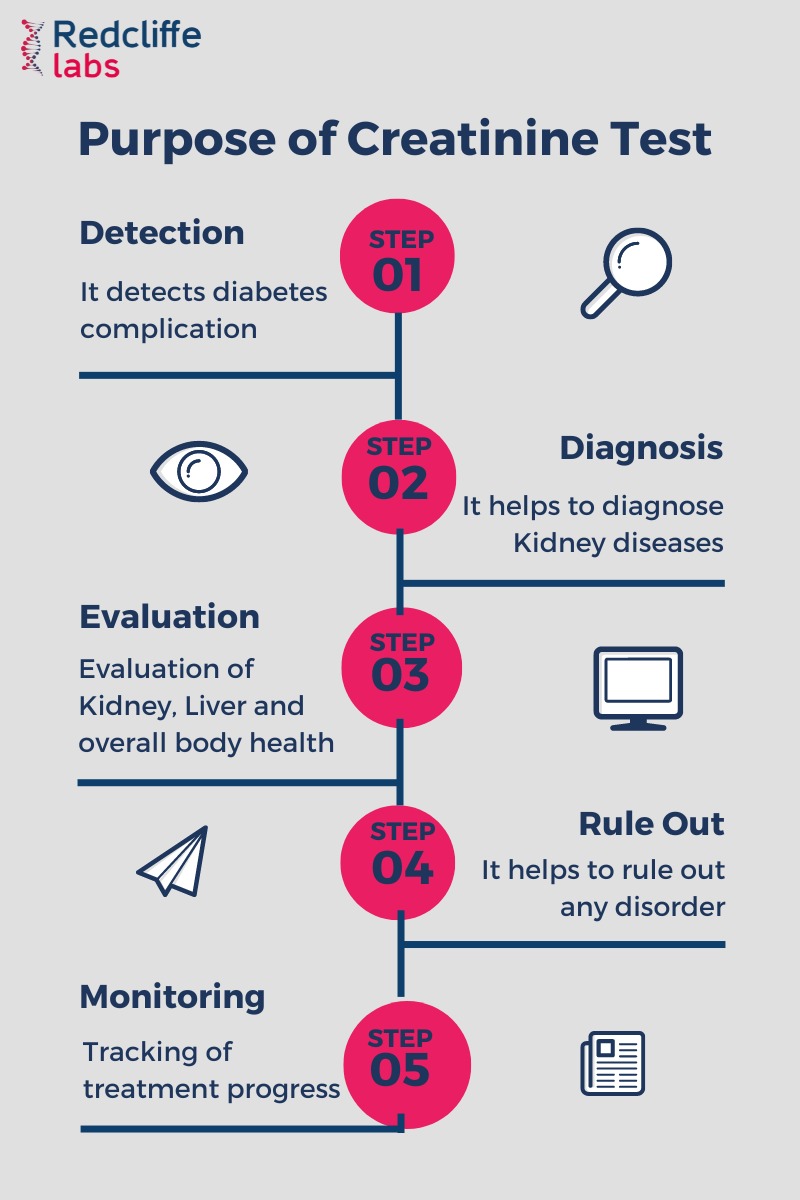
- Creatinine tests are used to screen, diagnose, and monitor kidney (renal) disorders, including chronic kidney disease and acute renal failure.
- It can also be used to evaluate how other diseases, such as heart and liver disease, impact the kidneys.
Helps you know your test better
Q. How can I book my test?
Q. In how much time will I get my test report?
Q. Where can I see or get my test results?
Q. Is home sample collection available for Creatinine test?
Life in Noida often means long office hours, a longer commute, and not much time left over for routine health checks. Kidney problems tend to fit right into that gap — they can develop quietly, for years, before anything feels wrong. Chronic kidney disease is a real and growing health concern in India, and because it rarely announces itself early, a simple blood test is often the first real clue.
A Creatinine Test measures the amount of creatinine in your blood. On its own, it's a small, unassuming number — but it tells you and your doctor a great deal about how well your kidneys are doing their job. Redcliffe Labs offers a Creatinine Test in Noida with home sample collection and digital reports, so staying on top of your kidney health doesn't mean rearranging your day around a lab visit.
What Is Creatinine?
Creatinine is a natural waste product that forms when your muscles use energy. Your body makes it every day, and the amount varies with your age, sex, body size, muscle mass, diet, and activity level.
Your kidneys do three things with it:
- They filter creatinine out of the blood.
- They pass it into the urine.
- They help keep the blood level fairly stable, day to day.
When the kidneys aren't filtering well, creatinine builds up in the blood. But kidney health isn't the only thing that moves this number — dehydration, a heavy meat meal, intense exercise, muscle injury, creatine supplements, and certain medicines can all raise it too, which is exactly why one raised reading is a starting point for questions, not a diagnosis.
What Is a Creatinine Blood Test?
A Creatinine Blood Test measures creatinine in a blood sample. Doctors commonly use it to assess kidney filtration, monitor an existing kidney condition, or check whether a medicine is affecting kidney function.
| Parameter | What It Measures | How Doctors Use It |
|---|---|---|
| Creatinine, serum | The amount of creatinine in the blood | Supports kidney-function assessment and helps doctors decide whether you need an eGFR, urine albumin test, Kidney Function Test, or another investigation |
How Does Creatinine Relate to Kidney Function?
Healthy kidneys remove most creatinine from the blood as a matter of course. When filtration falls, the blood creatinine level tends to rise. Doctors also use serum creatinine to calculate the estimated glomerular filtration rate, or eGFR — a number that gives a clearer picture of kidney function because it factors in creatinine alongside things like your age and sex.
Doctors often look at eGFR together with a urine albumin-to-creatinine ratio, or UACR, because the two tests tell you different things:
- Serum creatinine measures a waste product in the blood.
- eGFR estimates how well the kidneys are filtering blood.
- UACR checks whether albumin, a blood protein, is leaking into the urine.
A normal creatinine result doesn't automatically mean your kidneys are in perfect health. Regular testing — including eGFR and UACR when your doctor recommends it — helps you stay ahead of the picture, especially if you have risk factors or symptoms.
What Is Creatinine Clearance?
Before eGFR became the standard, doctors estimated kidney filtration using creatinine clearance — a calculation based on a blood sample plus a timed urine collection. It measures how much blood the kidneys clear of creatinine every minute. In a healthy young adult, that's roughly 85–125 mL per minute for women and around 95–140 mL per minute for men, though the exact figure varies with age, muscle mass, and body size.
eGFR has largely taken over in everyday practice because it only needs a blood sample, not a 24-hour urine collection. But creatinine clearance still comes up, particularly when a doctor wants a more direct filtration measurement than eGFR alone provides.
Reasons You May Need a Creatinine Test in Noida
A doctor may recommend a Creatinine Test for a routine checkup, a symptom assessment, treatment monitoring, or as a follow-up to an earlier result. You may need the test if you:
- Want to check your kidney health: the result gives useful information about how well your kidneys may be filtering waste.
- Have diabetes: high blood sugar can damage the small blood vessels in the kidneys over time, and regular checks help catch changes early.
- Have high blood pressure: uncontrolled blood pressure can damage the kidneys' filtering system — and kidney problems can, in turn, make blood pressure harder to control.
- Have heart or blood-vessel disease: heart and kidney health are closely linked; reduced blood flow or heart failure can affect kidney function.
- Have a family history of kidney disease: your doctor may suggest testing if a close relative has chronic kidney disease or kidney failure.
- Previously had an abnormal kidney result: repeat testing helps your doctor see whether the change was temporary, stable, or getting worse.
- Live with chronic kidney disease: regular results help your doctor monitor function and review your treatment plan.
- Had an acute kidney injury: follow-up testing can show whether kidney function has recovered after an illness, infection, surgery, or hospital stay.
- Take medicine that can affect the kidneys: some medicines need kidney monitoring or dose adjustments. Never stop a prescribed medicine on your own.
- Need a test before a scan or procedure: doctors often review kidney function before certain procedures or contrast-based imaging.
If you're in Noida, home sample collection makes this kind of monitoring genuinely simple — no early-morning lab queue, no rearranging your commute. Your doctor will guide you on whether a standalone Creatinine Test is enough, or whether a full Kidney Function Test makes more sense for your situation.
Who Should Consider a Creatinine Test in Noida?
Speak with a doctor about kidney testing if you:
- Have diabetes, high blood pressure, or heart disease
- Are over 50 with kidney-disease risk factors
- Have obesity or use tobacco
- Have a family history of kidney disease or kidney failure
- Have repeated urinary infections or a history of kidney stones
- Notice swelling in your feet, ankles, hands, or around your eyes
- Pass noticeably less or more urine than usual, or find it painful
- Notice blood, foam, or an unusual colour in your urine
- Have unexplained tiredness, nausea, itching, or muscle cramps
- Recently had severe dehydration, infection, surgery, or major blood loss
- Take medicines that need kidney-function monitoring
- Have received treatment for cancer or an autoimmune condition
- Need monitoring during pregnancy because of a health concern
- Had an abnormal creatinine, eGFR, urine protein, or KFT result before
Children, pregnant women, older adults, and people with very high or low muscle mass need individual interpretation — follow the advice of your paediatrician, obstetrician, nephrologist, or treating doctor rather than a general reference range.
Does High Creatinine Cause Symptoms?
Not usually, on its own. Many people feel completely fine when a routine test first turns up an abnormal number — the symptoms people associate with kidney trouble usually come from whatever's affecting the kidneys, not from the creatinine itself. Possible signs of a kidney problem include:
- Swelling: fluid collecting around the ankles, feet, hands, or eyelids.
- Changes in urination: passing noticeably more or less urine than usual, or noticing it's foamy, dark, or bloody.
- Tiredness: waste buildup, anaemia, or the underlying condition can leave you feeling drained.
- Nausea or poor appetite: reduced kidney function can affect digestion.
- Dry or itchy skin: more advanced kidney problems can cause persistent itching.
- Muscle cramps: shifts in fluid or minerals can trigger cramping.
- Breathlessness: extra fluid, or an underlying heart or kidney issue, can make breathing harder.
- Trouble concentrating: significant waste buildup can affect alertness and clear thinking.
All of these can show up with plenty of other conditions too, so a creatinine test plus a proper medical assessment is what actually identifies the cause.
Seek urgent medical care if you have very little or no urine output, severe breathlessness, chest pain, confusion, fainting, rapidly worsening swelling, persistent vomiting, blood in the urine with severe pain, or a sudden decline in how you feel after an illness.
What Can Raise Creatinine Levels?
Several kidney-related and non-kidney factors can push serum creatinine up:
- Acute kidney injury: severe dehydration, infection, low blood pressure, surgery, or another sudden illness can reduce kidney filtration.
- Chronic kidney disease: diabetes, high blood pressure, and other long-term conditions can gradually damage the kidneys.
- Urinary blockage: a kidney stone, enlarged prostate, or other obstruction can prevent normal urine flow.
- Kidney infection or inflammation: infections and immune-related kidney conditions can affect filtration.
- Reduced blood flow to the kidneys: heart failure, severe blood loss, or shock can all reduce kidney blood flow.
- Muscle injury: major muscle damage releases substances that raise creatinine and can also harm the kidneys directly.
- Dehydration: low fluid levels temporarily concentrate creatinine in the blood.
- A heavy meat meal: cooked meat, eaten in quantity, can temporarily raise the result.
- Intense exercise: a hard workout can raise creatinine for a short time.
- High muscle mass: more muscle generally means more creatinine production.
- Creatine supplements: common in sports and bodybuilding, these can shift creatinine levels.
- Certain medicines: some change kidney function directly, others change how the body handles creatinine.
A high result doesn't automatically mean permanent kidney damage. Your doctor will weigh the number against your symptoms, medical history, previous reports, eGFR, urine findings, and other test results before drawing any conclusions.
How Should You Prepare for a Creatinine Test in Noida?
The good news: a standalone creatinine test doesn't require fasting. A few things are worth keeping in mind before your sample is collected:
- Check your booking instructions. If you've booked creatinine alongside other tests — HbA1c or thyroid tests, for example — you may need to fast for those. Creatinine alone usually doesn't require it.
- Stick to your usual diet, though your doctor may ask you to skip cooked meat beforehand, since it can temporarily raise the result.
- Drink your normal amount of water. Being reasonably hydrated makes the blood draw easier. Follow your doctor's advice if you're on a fluid restriction, or living with heart failure or kidney disease.
- Avoid an unusually intense workout beforehand — ask your doctor if you're unsure whether your routine counts.
- Mention creatine supplements, protein powders, or gym supplements to your doctor. Don't stop them unless you're told to.
- Share your full medicine list — prescriptions, painkillers, antibiotics, over-the-counter products, vitamins, and supplements.
- Continue your prescribed treatment. Don't stop or change any medicine on your own.
- Mention any recent illness — fever, vomiting, diarrhoea, infection, surgery, muscle injury, or dehydration.
Always follow the specific instructions on your booking and whatever your doctor has advised for your situation.
How Does Home Sample Collection Work?
The whole thing usually takes only a few minutes, and it's less clinical than it sounds.
- Confirm the booking: the phlebotomist verifies your name, the test booked, and your appointment details — they may ask for an OTP.
- Prepare the site: they'll clean the skin, usually on the inside of your elbow, and apply a tourniquet to help locate the vein.
- Collect the sample: using sterile, single-use equipment, they draw a small amount of blood into the correct tube. You'll likely feel a brief pinch as the needle goes in — that's about the extent of it, and any soreness or bruising afterward usually settles quickly.
- Label the tube with your patient and collection details on the spot.
- Transport the sample to the laboratory in a temperature-controlled bag, under defined conditions, to keep the result reliable.
- Analyse the sample for serum creatinine.
- Share the report through whichever digital channel suits you — WhatsApp, email, the website, or the app.

If your doctor has asked for a urine-based creatinine measurement instead — often alongside a creatinine clearance calculation or a UACR — the process looks a little different, since it involves a full 24-hour collection rather than a single sample:
- In the morning, urinate as normal and empty your bladder. You don't need to keep this first sample, but do note the exact time.
- For the next 24 hours, collect every subsequent urination into the sterile container your phlebotomist provides.
- Keep the container cool throughout — a fridge, or an ice pack, works well.
- Once the 24 hours are up, the sample is collected and sent to the lab alongside your blood draw.
Redcliffe Labs' contactless process means you're not travelling back and forth for either sample or report — reports reach you digitally, typically the same day.
Understanding Creatinine Test Results
Labs can use slightly different methods and reference ranges, and factors like age, sex, body size, muscle mass, pregnancy, diet, hydration, activity, and medicines can all shift the number. Common adult reference ranges look like this:
| Group | Typical Serum Creatinine Range | What to Remember |
|---|---|---|
| Adult men | 0.74–1.35 mg/dL | Higher muscle mass can raise creatinine even when kidney function is perfectly stable |
| Adult women | 0.59–1.04 mg/dL | Pregnancy, body size, and muscle mass can shift the expected range |
Always go by the reference range printed on your own report rather than a number you've read elsewhere — children use age-based ranges, and individual labs may report slightly different limits.
Doctors rarely look at creatinine in isolation. They'll often also weigh in your previous results, the direction and speed of any change, your eGFR, urine albumin or UACR, blood urea nitrogen, electrolytes, blood pressure and blood sugar, and your current medicines, symptoms, and hydration.
What Can a High Creatinine Result Mean?
A high result simply means the level is above the reference range for you — it suggests the kidneys may not be filtering waste quite as well as expected, but it doesn't identify why on its own. It could relate to acute or chronic kidney disease, dehydration or recent fluid loss, a kidney infection or blockage, reduced blood flow to the kidneys, diabetes or high blood pressure affecting kidney health, heart failure, severe muscle injury, a recent intense workout, a large meat meal, high muscle mass, creatine supplements, or certain medicines.
Your doctor may repeat the test and request an eGFR, urine albumin, a complete Kidney Function Test, or imaging to narrow things down.
What Can a Low Creatinine Result Mean?
A low creatinine level is less common, and it doesn't usually point to kidney failure — it tends to happen when the body simply produces less creatinine in the first place. Possible reasons include low muscle mass, age-related muscle loss, malnutrition or low body weight, a long-term illness causing muscle loss, pregnancy, severe liver disease, or an amputation or muscle-wasting condition.
A low result can also make creatinine-based eGFR look better than someone's actual kidney function really is. In these cases, a doctor may use an alternative marker, such as cystatin C, when muscle mass makes creatinine tricky to interpret on its own.
What Can Affect a Creatinine Result?
Beyond kidney health itself, several things can shift the number or how it should be read: hydration and recent fluid loss, cooked meat and general diet, creatine or bodybuilding supplements, strenuous exercise, muscle mass, age and body size, muscle injury or muscle-wasting conditions, pregnancy, fever, infection or recent surgery, diabetes, high blood pressure and heart disease, liver disease, and medicines that affect the kidneys or how the body handles creatinine.
Share anything relevant with your doctor — but don't change your diet, water intake, supplements, or medicines purely to try to shift a lab value.
Creatinine Test vs eGFR, KFT, and Urine Tests
These tests sound similar but each tells you something different:
| Test | Commonly Included Measurement | Main Use |
|---|---|---|
| Serum Creatinine Test | Creatinine in blood | Basic kidney-filtration marker, and the value used to calculate eGFR |
| eGFR | Estimate calculated from creatinine and personal factors | A clearer estimate of overall kidney filtration |
| Kidney Function Test | Commonly includes creatinine, urea or BUN, uric acid, and electrolytes (exact panel varies) | A broader view of kidney-related blood markers |
| Urine Albumin-to-Creatinine Ratio | Albumin compared with creatinine in urine | Checks for albumin leakage — often an early sign of kidney damage |
| Creatinine Clearance | Blood creatinine plus timed urine creatinine | Estimates how much creatinine the kidneys clear from the blood |
Can a Creatinine Test Diagnose Kidney Disease?
Not by itself. An abnormal result can support an assessment of kidney function, but it can't confirm a specific kidney disease on its own. Doctors typically investigate further with repeat creatinine testing, eGFR, urine albumin or UACR, urine routine and microscopy, urea, BUN and electrolytes, blood pressure and blood sugar, imaging such as an ultrasound, and a review of your medical history, medicines, and symptoms.
Chronic kidney disease specifically requires evidence that a kidney abnormality has persisted for at least three months. A sudden rise, by contrast, can point to acute kidney injury and may need urgent medical attention.
How Often Should You Check Creatinine?
This depends on your age, risk factors, medicines, symptoms, and previous results — but as a general guide:
- Healthy adults without risk factors: often included in a routine health check, without needing a separate test at fixed intervals.
- People with diabetes: kidney screening is generally recommended every year, typically pairing an eGFR blood test with a urine albumin test.
- People with high blood pressure, heart disease, or a family history of kidney failure: ask your doctor how often testing makes sense for you.
- People with chronic kidney disease: testing may happen every few months, depending on the stage, treatment, and stability of the condition.
- People on medicines that affect kidney function: often tested before starting treatment, after a dose change, or at set intervals.
- People recovering from acute kidney injury: repeat testing confirms whether function is improving.
- Anyone with an abnormal result: your doctor may want an earlier-than-usual repeat to see whether it's holding steady.
Follow your doctor's recommended schedule rather than repeating the test more often than advised.
Creatinine Test Price in Noida
| Name of the Test | Creatinine Test in Noida |
| Sample Type | Blood |
| Number of Parameters | 1 |
| Actual Test Price | Rs. 373 |
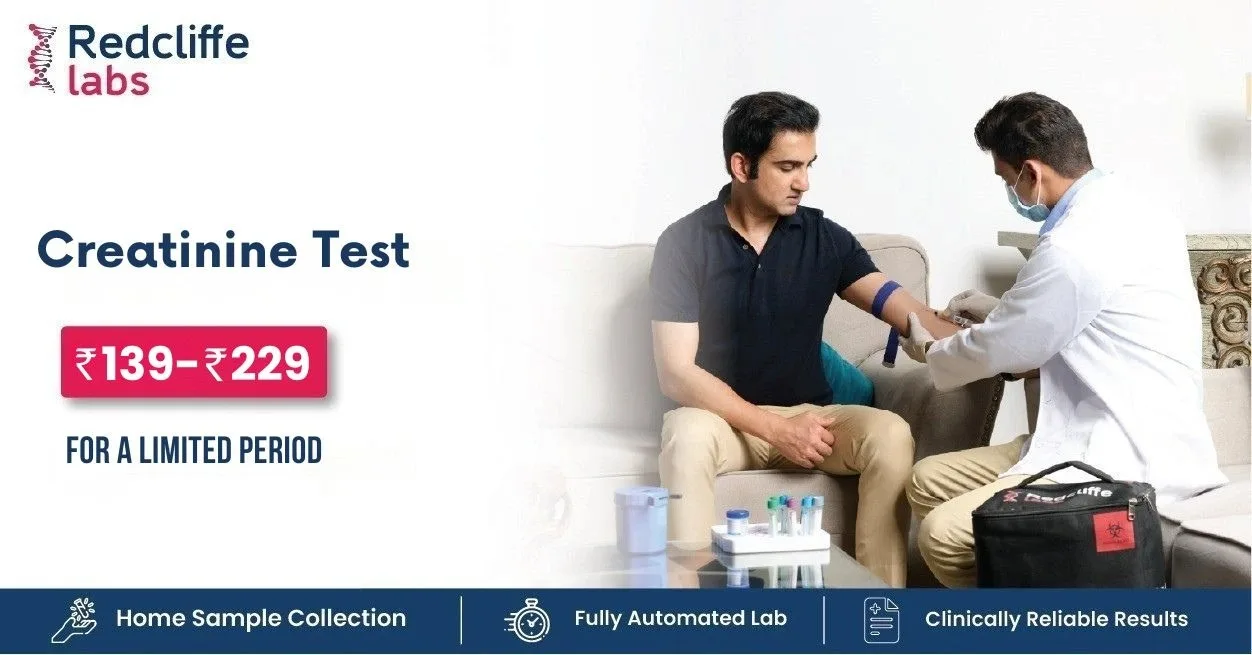
| Discounted Test Price | Rs. 139 |
| Home Sample Collection | Available |
| Additional Cost for Home Collection | Applicable |
| Fasting Before Test | Not Required |
| Get Reports Within | Same Day |
Note: We also offer the Creatinine Test PAN India. Call 898 898 8787 to check availability and pricing in your area.
Creatinine test pricing can vary by city, based on factors like diagnostic infrastructure, equipment, and accreditation. A lab with strong NABL and ISO accreditation may charge a little more, but it also means a more consistent, quality-controlled process behind your result.
How to Book a Creatinine Test with Redcliffe Labs
Booking a Creatinine Test in Noida takes just a few steps:
- Visit the website or app: open the Redcliffe Labs website or mobile app.
- Search for the test: look up the creatinine test.
- Review the details: confirm the parameter included, sample type, fasting instructions, and report time.
- Add the test to your cart.
- Enter patient information: name, age, sex, and contact details.
- Add the collection address: complete address, sector, landmark, and PIN code.
- Choose a slot: pick a convenient date and time for home collection.
- Review the final amount: test price, discount, diagnostic fee, and any other charges.
- Confirm the booking and complete payment.
- Be available when the phlebotomist arrives, and share the verification details they ask for.
- Access your report online — view, download, or share it with your doctor once it's ready.
Prefer to book by phone? Call 898 898 8787 and a representative will walk you through the same process.
Why Choose Redcliffe Labs in Noida?
- Convenient home collection: choose a slot and provide your sample at home instead of travelling to a centre.
- Trained phlebotomists: the collection team follows defined procedures for verification, hygiene, blood collection, labelling, and transport.
- NABL-accredited testing: your sample is processed under defined quality-control standards, rather than an unmonitored process.
- Digital reports: access your result through the app, website, email, or WhatsApp, and share it with your doctor in a tap.
- Transparent pricing: the price, discount, home-collection charge, prep instructions, and turnaround time are all visible before you book — no surprises at checkout.
- A wide diagnostic network: Redcliffe Labs operates across 220+ cities through 80+ labs, offering more than 3,600 diagnostic tests.
Every test also comes with what we call the 4X Value Benefits:
- Smart Reports that turn dense lab data into clear summaries, health scores, and trend tracking, so you can actually see what's changing over time.
- Expert-led report consultation, where someone talks you through your results and possible next steps.
- An AI Health Assistant for round-the-clock first-step guidance and help understanding your report.
- Goal-based improvement plans — personalised diet and lifestyle guidance built around your own results.
These services offer general guidance and support — they don't replace diagnosis, treatment, nephrology care, or emergency medical services.
Other Kidney-Related Tests You Can Book
If your doctor has suggested a broader check, or you'd simply like a fuller picture of your kidney health, these are commonly booked alongside a Creatinine Test:
| Test / Package | Price (INR) |
|---|---|
| Uric Acid Test | ₹149–₹219 |
| Kidney Function Test (KFT) | ₹369–₹499 |
| Vital Screening Package | ₹799 |
| Smart Full Body Checkup | ₹997 |
| Fit India Full Body Checkup with Free HbA1c | ₹1249 |
| Smart Plus Full Body Checkup with Vitamin Screening | ₹1799 |
| Advance Full Body Checkup | ₹1799 |
Home Collection Across Noida
Home sample collection is available across Sector 18, Sector 44, Sector 50, Sector 62, Sector 63, Sector 76, Sector 78, Sector 93, Sector 104, Sector 137, Sector 142, Noida Extension, and nearby areas. Enter your complete address and PIN code at booking to confirm coverage, available slots, and any applicable collection charge.
What Should You Do After Receiving the Report?
- Check the patient name, age, sample date, unit, and reference range.
- Confirm the report shows serum creatinine specifically.
- Compare it against earlier reports, if you have them.
- Pay attention to the direction of change, not just the single number.
- Share a high, low, or unexpected result with a qualified doctor.
- Ask whether the report includes eGFR, or whether that needs a separate calculation.
- Ask whether you need a UACR, KFT, urine test, or another investigation.
- Mention any recent dehydration, illness, hard exercise, heavy meat intake, supplements, or medicines to your doctor.
- Don't stop medicine, cut out all protein, or drink excessive water on your own, without medical advice.
- Seek prompt care for severe symptoms or a rapidly rising result.
- Save the report so your doctor can track changes over time.
Book Your Creatinine Test in Noida Today
Kidney problems tend to stay quiet in their early stages — that's exactly why a Creatinine Test is worth having on your radar, whether you're checking a specific concern or simply keeping an eye on things. Your doctor can read the number alongside your eGFR, urine findings, symptoms, medicines, and history to build a picture that a single result never could on its own.
Book a Creatinine Test in Noida with Redcliffe Labs for home sample collection and a digital report, and check the current price, collection charge, and available slots before you confirm.