
PSA Test: Price, Purpose, Procedure, Results & Home Collection
This test measures prostate-specific antigen levels in your blood to evaluate prostate health and help screen for or monitor prostate conditions, including prostate cancer.




Blood


Unlock special
discount on
this package
Login to Unlock 🔓
1 Test Parameters

Prostate Specific Antigen (PSA) Total
1 PARAMETER INCLUDED
1 PARAMETER INCLUDED
- PSA - Total (Prostate Specific Antigen)
Helps you know your test better
Who all are eligible for PSA test?
- Males between the ages of 18 and 99 years.
- In case of Prostate medical history in men.
- People with frequent urination, pain and burning during urination, stiffness and pain in their hips, lower back, rectal, and pelvic regions, urine dribbling, and problems with bladder control.
- In case of any abnormalities with male testicles.
Why take PSA Lab test?
- This test helps to detect prostate cancer.
- Prostate antigen levels in the blood are measured to determine whether a prostate tumour is cancerous or non-cancerous.
What are the benefits of PSA test?
- It limits the spread of tumors by early detection and treatment.
- It is necessary to be aware of one's prostate status to prevent such diseases.
- It has become easy to treat and cure prostate gland-related illnesses, such as BPH, enlarged prostate, and prostatitis.
Helps you know your test better
Q. What PSA Level Indicates Prostate Cancer?
Q. How can I book my test?
Q. In how much time will I get my test report?
Q. Where can I see or get my test results?
Q. Is home sample collection available for PSA test?
Table of Content
Introduction to the PSA Test
The prostate is a small gland in the male body responsible for producing fluids that nourish and transport sperm. Prostate Cancer is one of the most common cancers in men. Due to embarrassment or lack of awareness, most people don’t even talk about it, which leads to a delay in diagnosis until the later or more severe stage. It is the major reason behind the rising cases at an alarming rate. Doctors often suggest a PSA Test to screen for prostate cancer in men. Usually, PSA is produced due to normal and cancerous reasons, and a PSA Test helps measure the prostate-specific antigen to help with the early detection of cancer and ensure better management of the condition.
Remember, the PSA Blood Test doesn’t confirm prostate cancer diagnosis; it only suspects it, and depending on your test results, medical history, symptoms, and other clinical evaluations, your healthcare practitioner may suggest additional tests. PSA levels can be elevated for many reasons, like infection, inflammation, and other cancerous or non-cancerous conditions. Further evaluation is essential for accurate diagnosis if the test shows elevated levels.
Redcliffe Labs is one of the growing diagnostic service providers that you can consider to book a PSA Test from the comfort of your home. In addition, we provide express slots to help you get your sample picked within 45 minutes. So, delay no more and book a Prostate Cancer-Specific Antigen Test with us now.
What Is a PSA Test?
PSA stands for Prostate-Specific Antigen, a protein made by prostate cells. The PSA test is a blood test that measures the PSA level in your blood. PSA is a protein produced by the prostate gland. It is primarily used as a screening tool to detect prostate cancer early, as well as to monitor men who have already been diagnosed with or treated for the disease.
Test Details In Brief:
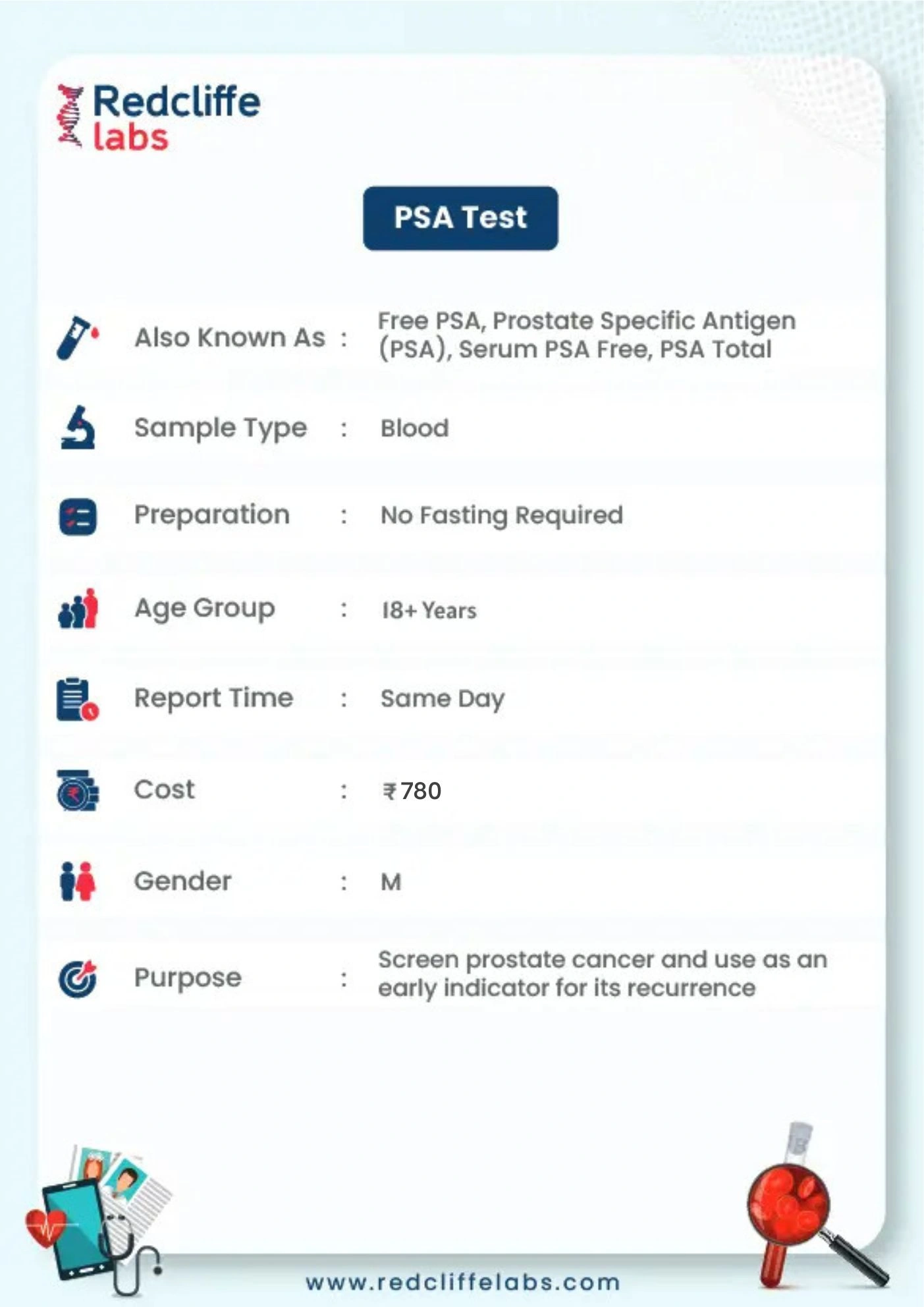
| Also Known As | Free PSA, Prostate Specific Antigen (PSA), Serum PSA Free, PSA Total, |
| Purpose | Screen prostate cancer and use as an early indicator for its recurrence |
| Preparation | Do not take any over-the-counter medicine without confirming with your doctor |
| Fasting | No Fasting Required |
| Get Reports Within | Same Day |
| Cost | INR 769 |
Reasons You May Need A S. PSA Test:
While the PSA Test is suggested as routine screening to assess your risk, diagnose the problem early, and enable timely treatment for better management, certain factors might prompt a need for this test. Some of the common reasons your doctor may suggest you go for a Prostate-Specific Antigen Blood Test are:
- Age: Your age is the biggest factor contributing to a higher prostate cancer risk. Therefore, men aged 50 or more are usually suggested to undergo PSA Testing. However, the age range may vary depending on your health condition or family history.
- Family History: Another factor that prompts the need for a PSA Blood Test is having a first-degree relative with a history of prostate problems or prostate cancer. Having it in the genetics increases your risk of being affected, and doctors may recommend testing for early or routine PSA screening to assess your risks.
- Having Symptoms: Besides being recommended as a part of routine screening, PSA Blood Test may be recommended to individuals experiencing symptoms related to Prostate problems.
Types of PSA Tests: What’s the Difference?
Different PSA tests measure different forms of Prostate-Specific Antigen (PSA) in the blood. Each test provides additional information about prostate health and helps doctors assess the risk of prostate cancer or other prostate conditions.
- PSA profile test: A PSA Profile Test assesses your prostate health, which includes Total PSA, Free PSA, and % Free PSA. The test helps to evaluate prostate cancer risk and differentiate between benign and malignant prostate conditions.
- Prostate Specific Antigen (PSA) Free Test: The Free PSA Test measures the amount of PSA circulating freely in the blood without being attached to proteins. It is used along with Total PSA to help determine the likelihood of prostate cancer.
- Prostate-Specific Antigen (PSA) Total Test: The Total PSA Test measures the total amount of PSA in the blood. It is commonly used for prostate cancer screening, prostate health evaluation, and monitoring prostate-related conditions.
Who Should Get a PSA Test?
A PSA (Prostate-Specific Antigen) Test is commonly used to assess prostate health and screen for potential prostate-related conditions, including prostate cancer.
You should consider a PSA Test if you:
- Are you a man aged 50 years or older and discussing routine prostate screening with your doctor?
- Are aged 45 years or older and have a family history of prostate cancer.
- Have a father, brother, or close relative diagnosed with prostate cancer.
- Experience frequent urination, especially at night.
- Have difficulty starting or stopping urination.
- Notice a weak or interrupted urine stream.
- Feel pain or burning during urination.
- Experience blood in the urine or semen.
- Have pelvic discomfort or unexplained lower back pain.
- Need monitoring for an enlarged prostate (BPH) or previous prostate conditions.
- Have previously been treated for prostate cancer and require follow-up monitoring.
Your doctor may recommend a PSA test based on your age, symptoms, family history, overall health, and individual risk factors. The test is often combined with a physical examination and other diagnostic evaluations for a complete prostate health assessment.
Symptoms That May Call For A Prostate-Specific Antigen Test:
- Urinary Symptoms: Individuals with prostate cancer or prostate-related problems may experience symptoms related to urinary, such as:
- Frequent urination
- Difficulty starting or stopping urine
- Weak urine flow
- Painful urination
- Leakage of urination
- A feeling of incomplete bladder emptying
- Pain Or Discomfort: Apart from urination problems, individuals with prostate problems or prostate cancer may also complain of persistent pain or discomfort in:
- Lower back
- Pelvis
- Hips
- Thighs
- Blood In Urine: Lastly, visible blood spots in urine or semen are a clear-cut sign that something is not right, and the prostate could be one of the reasons.
In short, doctors may consider collaborative factors, like age, medical history, symptoms, and more, to recommend the PSA Lab Test. Getting tested in time is critical to find the root cause or to diagnose the problem accurately. Delaying the diagnosis of prostate cancer can worsen the symptoms, and therefore, it should never be pushed off for any reason. As suggested by your healthcare practitioner, getting tested should be your top priority to diagnose the problem early and prevent complications to a possible extent.

Purpose Of A PSA Screening:
Here are some common purposes served by a S PSA Test.
- Assess The Risk Of Prostate Cancer: Prostate-specific antigen screening assesses the health of the prostate gland in men while assessing their risk of prostate cancer.
- Helps With Early Diagnosis: The test measures prostate-specific antigens in the blood to help diagnose prostate issues, like prostate cancer, allowing early intervention and treatment.
- Help Find The Cause: Elevated PSA levels don’t always mean prostate cancer, and the test helps find the cause of prostate conditions that are not cancerous.
- Enable Timely Treatment: Getting tested routinely in time may help you take proactive measures before things turn ugly. It enables you to initiate treatment for better management of the condition.
- Monitor Treatment: Lastly, by measuring PSA levels in the blood, the test helps check the efficacy of the treatment and enables adjustment as required.
In short, getting tested in time for prostate cancer is essential so the worst can be avoided to a possible extent. Redcliffe Labs is your trusted diagnostic partner from where you can book PSA Blood Screening at home without compromising your comfort. So, book now.
Preparations Required For A PSA Test:
General guidelines for PSA Test Preparation that one may be advised to follow during a PSA Test are:
- It requires no fasting, but discussing this with your healthcare practitioner is essential if you are on a special diet.
- Moreover, individuals taking prescribed or non-prescribed medicines, like supplements, may be advised to inform their healthcare provider before the test so that they can instruct accordingly.
- It is always advisable to sleep well before the test and stay calm while blood is being drawn, as it can otherwise influence your hormones and cause discrepancies in the test results.
- Lastly, if your doctor has suggested any specific instructions, follow them as it is to ensure results are accurate.
Remember, following the instructions is essential for appropriate measurements and accurate diagnosis. If you have any doubts or concerns about the test, procedure, or preparations, you should discuss them with your healthcare provider.
Procedure Of A PSA Test:
It is a simple blood test that includes the following steps:
- During the process, your phlebotomist may ask you to sit comfortably.
- They will tie a band around the arm and ask you to make a fist to find the vein.
- Once the vein is visible, they may use a sterilized needle to withdraw blood.
- The collected blood will then be transferred to the vial for further processing.
The procedure will take 5-10 minutes and has no potential risks. However, the procedure may cause discomfort, pain, or bruise at the punctured site. In rare cases, one may experience infection, and if you experience anything unusual, seek medical attention immediately.

What Levels Are Checked in a PSA Test?
Total PSA: The test measures the total amount of PSA circulating in the blood. This is the most commonly used marker for prostate health assessment.
What Do These Levels Help Detect?
- Prostate cancer
- Benign Prostatic Hyperplasia (BPH)
- Prostatitis (prostate inflammation)
- Prostate enlargement
- Monitoring after prostate cancer treatment
Doctors interpret PSA levels alongside age, symptoms, family history, digital rectal examination (DRE), imaging studies, and previous PSA results to achieve a more accurate assessment.
What Affects PSA Test Results?
Several factors can influence PSA (Prostate-Specific Antigen) levels, causing them to rise or fall even when prostate cancer is not present.
- Benign Prostatic Hyperplasia (BPH): An enlarged prostate can raise PSA levels.
- Prostatitis: Inflammation or infection of the prostate can significantly increase PSA levels.
- Urinary Tract Infection (UTI): Can temporarily elevate PSA levels.
- Age: PSA naturally tends to increase as men get older.
- Vigorous Cycling: Pressure on the prostate may temporarily raise PSA.
- Some Herbal Supplements: Certain supplements may affect PSA measurements.
- Obesity: Increased weight may result in lower measured PSA concentrations due to blood-volume effects.
- Certain Hormonal Treatments: Testosterone-suppressing therapies can reduce PSA levels.
- Previous Prostate Cancer Treatment: Surgery, radiation, or hormone therapy often lowers PSA.
2: What Conditions Can Be Diagnosed With a PSA Test?
- Prostate Cancer: Elevated PSA levels can be an early sign of prostate cancer, even before symptoms develop. Additional tests such as imaging or a biopsy are needed to confirm the diagnosis.
- Benign Prostatic Hyperplasia (BPH): BPH is a non-cancerous enlargement of the prostate gland that commonly occurs with aging. The enlarged prostate can increase PSA levels and cause urinary symptoms.
- Prostatitis: Prostatitis is inflammation or infection of the prostate gland. It can cause a sudden rise in PSA levels along with pelvic pain, urinary discomfort, or fever.
- Recurrent Prostate Cancer: For men previously treated for prostate cancer, PSA testing helps detect whether the cancer has returned. Rising PSA levels after treatment may indicate recurrence.
- Advanced or Metastatic Prostate Cancer: Very high PSA levels may suggest that prostate cancer is advanced or has spread beyond the prostate. Further imaging tests are usually required to determine the extent of the disease.
- Prostate Inflammation: Even without infection, inflammation of prostate tissue can elevate PSA levels. Doctors may repeat the test after the inflammation resolves to reassess PSA values.
- Urinary Tract Disorders Affecting the Prostate: Certain urinary tract infections or conditions that irritate the prostate can temporarily increase PSA levels. PSA testing can help identify when further evaluation is needed.
PSA Test Normal Range:
Generally, PSA levels of 4.0 ng/mL and lower are considered normal. Elevated PSA levels usually are the cause of concern and are often associated with prostate-related issues, cancerous or non-cancerous. Doctors consider factors like history, symptoms, current medical condition, and test reports for accurate PSA Test Result Interpretation.
Normal PSA Test Range by Age
PSA (Prostate-Specific Antigen) levels tend to increase gradually with age as the prostate naturally enlarges.
| Age Group | Common PSA Reference Range (Upper Limit) |
| 40–49 years | Up to 2.5 ng/mL |
| 50–59 years | Up to 3.5 ng/mL |
| 60–69 years | Up to 4.5 ng/mL |
| 70–79 years | Up to 6.5 ng/mL |
How to Read PSA Test Results? (High & Low PSA Levels Explained)
A PSA test measures the amount of PSA in the blood, reported in nanograms per millilitre (ng/mL).
| PSA Level | What It May Mean |
| Below 4 ng/mL | Generally considered within the normal range for many men, though prostate cancer can still be present in some cases. |
| 4-10 ng/mL | Borderline or moderately elevated. May be caused by prostate cancer, enlarged prostate, inflammation, or infection. |
| Above 10 ng/mL | Higher likelihood of prostate cancer, though non-cancerous conditions can also raise PSA levels. |
| Very low or undetectable PSA | Usually not concerning. May occur in younger men, after prostate removal, or while taking certain medications. |
High Levels of PSA Mean
A high PSA result does not automatically mean prostate cancer. Other possible causes include:
Benign Prostatic Hyperplasia (BPH) – non-cancerous enlargement of the prostate
- Prostatitis – inflammation or infection of the prostate
- Urinary tract infection (UTI)
- Recent ejaculation
- Recent prostate examination or procedure
- Aging (PSA tends to rise gradually with age)
Low PSA Levels Mean
Low PSA levels are generally reassuring and may indicate a lower risk of prostate cancer. PSA can be lower due to:
- Naturally, small prostate size
- Younger age
- Certain medications (such as 5-alpha reductase inhibitors)
- Previous prostate cancer treatment or prostate removal
- Normal Range: This is considered normal.
- Slightly high PSA: May occur due to benign prostate enlargement (BPH), prostatitis, urinary tract infection, or recent prostate stimulation.
- Elevated PSA: May require further evaluation for prostate cancer or other prostate conditions.
- Rising PSA over time: Even within the normal range, a steadily increasing PSA may need additional investigation.
Tips To Lower PSA Levels:
- Take A Healthy Diet: Eating clean can positively impact your health. So, to keep your PSA levels in balance, you should focus on eating fruits, vegetables, whole grains, and lean protein. While adding these foods to your diet, you should limit the consumption of processed food, saturated fats & sugar.
- Take Vitamin D: According to some studies, having adequate Vitamin D in the body can positively impact your prostate health and help lower PSA levels. However, the promising research is in progress, and therefore, adding it should be done, following the advice of your healthcare provider only.
- Maintain A Healthy Weight: Being overweight contributes to high PSA Levels. Therefore, if you are obese, you should shed some extra pounds that can otherwise influence your PSA levels and health in general.
- Be Physically Active: In addition, being physically active is essential to staying fit and lowering your PSA levels. You can include any physical activity, be it jogging, walking, weight lifting, or yoga, in your routine for overall well-being.
- Stay Hydrated: Drinking adequate water can solve various health issues and hold the utmost significance in keeping fit. So, drink plenty of water to maintain hydration, flush out toxins & maintain overall vitality.
- Watch Your Alcohol Intake: Excessive alcohol consumption can influence prostate health, leading to elevated PSA levels. Hence, you should limit the intake of alcohol or avoid it altogether.
- Regularly Check PSA Levels: Also, measuring PSA levels routinely is essential to keep track of the fluctuations and take preventive measures accordingly.
Remember, these are general tips that may impact different individuals differently. Hence, you should always take healthcare advice and follow their guidance for better health management and to improve your overall quality of life.
PSA Test vs Free PSA Test: What’s the Difference?
Both PSA and Free PSA tests measure prostate-specific antigen in the blood, but they provide different information about prostate health.
PSA Test (Total PSA)
- Measures the total amount of PSA in the bloodstream.
- Includes both protein-bound PSA and free PSA.
- Elevated levels may occur due to prostate cancer, enlarged prostate (BPH), prostatitis, or urinary tract issues.
- Often, the first test recommended when evaluating prostate health is the PSA test.
Free PSA Test
- Measures only the unbound (free) PSA circulating in the blood.
- Helps doctors determine whether an elevated PSA is more likely due to prostate cancer or a non-cancerous condition.
- A lower percentage of free PSA may be associated with a higher risk of prostate cancer.
- A higher percentage of free PSA is more commonly seen in benign prostate enlargement.
Key Differences
- Total PSA measures all PSA in the blood, while Free PSA measures only the PSA not attached to proteins.
- The Free PSA Test is usually used as a follow-up test when Total PSA results are unclear.
- Free PSA helps reduce unnecessary prostate biopsies in some men with moderately elevated PSA levels.
- Doctors often calculate the Free PSA/Total PSA ratio to better assess prostate cancer risk.
Both tests are interpreted along with age, symptoms, family history, digital rectal examination (DRE), imaging findings, and other clinical factors.
PSA Test Price @ Redcliffe Labs
As a trusted diagnostic service provider, we competitively quote our prices so everyone can access accurate and affordable diagnostics. With Redcliffe Labs, the PSA Test Price is just Rs 849. Not just this, from routine to specialized tests, you can book all with us at the most competitive rates possible. We aim to make our diagnostic services accessible to everyone at highly affordable rates. You can visit the nearest center or get tested comfortably from home. So, what are you waiting for? Book the PSA Test at reasonable rates with us now.
Other PSA Tests/Packages That You Can with Redcliffe Labs
| Tests/Packages | Price in INR |
| Prostate Specific Antigen (PSA) Free Test | ₹999 |
| Cancer Screening - Male | ₹1199 |
| Smart Full Body Checkup with PSA Test | ₹1299 |
| PSA Profile | ₹1550 |
| Super Advance Full Body Checkup Male | ₹3199 |
| Master Full Body Checkup Package - Male | ₹4699 |
PSA Test Sample Report - Redcliffe Labs

For a Routine PSA Test, Reach Redcliffe Labs Now!
Prostate Cancer is serious and can have life-threatening complications if left unaddressed. Therefore, early testing is essential to save you from the worst. It is not good to push your tests as it can only increase complications and other risks. So, why wait, and what for? Book your PSA Blood Test now. Redcliffe Labs is the best diagnostic service provider that you can count on to book a PSA Lab Test or PSA Test at home for just Rs 849. We follow ethical testing procedures and standards to ensure precise diagnostic experience and accurate reports. In addition, we provide express slots that help you get your sample picked from the comfort of your home within 45 minutes. Book now!